Home Blog Page 63

Track Guide: Barbagallo, Western Australia

0

Going all the way over to Western Australia to race motorbikes in the early days seemed like another country that you only ever read about once a year in the magazines when they reported the results of the Australian Championship round.

WA was like another world for the east coast, getting bikes and equipment out there to race was a logistical challenge.

The pictures always showed how much sand there was everywhere at Barbagallo and that the bikes stayed upright in the sand when they ran off the track, even when the riders were no longer on board! My first experience over there was in 1994 for the round of the Shell Oils Australian Road Race Championships.

The only viable option expenses-wise was for a whole group of riders to get together and crate all the bikes up in a pantec truck and get someone to drive them over and back via Mallala for their round of the Championship.

“With my dad having a Budget Rent a Car franchise, it meant one of his trucks was the chosen vehicle and all the other guys paid so much apiece for a place in the truck.”

Chris Taylor’s Dad, Alf, was the driver so he didn’t have to pay as driving was considered a pretty good contribution. A certain Troy Bayliss had his ZZR600 in the truck, too! This allowed the rest of us to fly over and see our bikes again at the racetrack. Everyone seemed to be on the same Qantas flight over from Sydney with all the factory Superbike riders of the day stationed up the back of the plane conducting the party.

We were staying at the Wanneroo Tavern with Phil Harper and his dad Bob and the Buckmasters – Malcolm and Damon. Phil knew the Buckmasters pretty well from the NSW Central Coast and they had advised us to stay there as it was pretty close to the track but could get a little noisy and rowdy on Thursday, Friday and Saturday night. 

With most riders having to fly out to Western Australia and stay for the weekend. Barbagallo round were always a weekend of partying.

That didn’t worry Malcolm though because he would just get up and go and sort them out. As a 17 year old I hadn’t had many nights out or seen too many things out of the ordinary such as topless waitresses on Thursday nights around the pool tables and a pub rocking all night, but the Wanneroo Tavern gave me all of those things. 

After dinner in the bistro on Thursday night, the old boys decided they needed a beer or two so we riders accompanied them in for a squash before official practice started the next day only to be greeted by naked ladies everywhere. Needless to say we probably drank all the squash in the joint before getting off to bed to get some sleep.


Check out our other track guides here…


The Saturday topped it all though when the general pub noise was getting louder and louder and I was sleeping like a log until woken yelling just outside our window. Dad was awake so we got up to see what was going on. 

Phil and Bob were up too with their door open and Malcolm was definitely up. Apparently one of the drunks had wandered over, obviously lost and had tried to get into their room through the window and Malcolm had come straight out ready to have this bloke. Upon seeing big Malcolm, the bloke shit himself. Realising he had made a big mistake on his room choice, he skipped up onto a car and then onto the motel roof to get away from Malcolm. 

The first thing you notice about the track is that there is sand everywhere. It’s pretty much built in the sand hills with a go-kart and motocross track also on the site.”

What we had heard was Malcolm telling this bloke to get down and accept his punishment and the bloke pleading with Malcolm to be let go in one piece. A good old-fashioned stalemate was what we had but it all ended peacefully and became a good story to tell about the Wanneroo Tavern. 

The track surface was very abrasive but also very grippy especially in the wet which I suppose it had to be considering when the wind came up the sand blew onto the track. The track goes clockwise so right, right, right most of the time, which I liked.

As Andrew grew older, together with his dad they would drive across the Nullarbour to get to the next round in SA.

As the years went on, dad and I did it together in a Hiace bus that went over on the train and we drove it back across the Nullarbor picking up Craig McMartin’s trailer after their vehicle had broken down in a race to get to Mallala for the next round. Needless to say the fuel economy went out the window towing the trailer across the desert coupled with the fuel prices out there. The year after, Peter Doyle agreed to throw our private ZX-6R in their truck and dad and I managed to get two third places against all the factory teams and that weekend probably got me started with Doyley and crew. At the very next round, the latest model I had been waiting for was ready and prepared by TKA and it led to second in the championship that year behind Damon Buckmaster.

The pit facilities were always good with competitors side by side in the carports in the early days, to the more upmarket lockable sheds that were generally privately owned and made available for the bigger teams over the weekend.

Barbagallo was all about flowing well through corners and carrying as much speed as possible on smaller bikes.

The Supersport bike was all about corner speed and maintaining momentum while the Superbike was all about getting it up and managing the wheel spin and hence tyre life. I have to say though, the Superbike was by far the most fun around there especially getting out of the bowl out the back.

The accommodation changed from the Wanneroo Tavern to Hillary’s Boat Harbour as things got better but it was always the round that everyone looked forward to all year – from the welcoming club and fans over there to the Sunday night parties in the clubhouse at the track. There was always the core group of workers headed by Denise that put on a great weekend and made everyone welcome and nothing had changed when I went back in 2009 for the Kings of Wanneroo.


“Thankfully an Australian Championship round has returned there because it was simply criminal they lost it and it’s not a real Australian Championship without going to Wanneroo.”


I told you I would finish the story of the rental car going around the adjacent motocross track so here are a few more details. Now I won’t mention any names and it was a few years before my time so maybe it’s just myth but as I said a rental car was rumoured to be taken around the motocross track and by the end it would only go in fifth gear and reverse. To make matters worse, it was bent through the middle and the doors wouldn’t open so when it was finally returned to the airport all occupants had to get out through the windows.

Summing up Wanneroo there is no doubt it always provides great racing and passionate spectators but by week’s end there will always be a few new stories to tell.

The track is made up of seven flowing and highspeed corners, coming in at just 2.45km long in its full layout.

TURN ONE
It has a pretty short front straight and depending on gearing, fifth gear was about as high as you would ever get (and sometimes only fourth). Normally you’re grabbing the brakes well past the end of the pit wall (around the pit lane exit), going back to third and running in really fast. It wasn’t a key overtaking spot but it could be done, you had to block the other rider a little, stopping yourself and trying to prevent running those couple of bike lengths wide allowing your competitor straight back past you on the inside. 

“Turn one has a pretty short front straight and depending on gearing, fifth gear was about as high as you would ever get (and sometimes only fourth).”

Third gear seemed generally a little tall on the entry but it made you keep it rolling around the long right to keep the corner speed up for the exit which ended up being a quick run up to the uphill left. Getting it up onto the fatter part of the tyre was important on the exit because it was very easy to lose that jump off the turn while it was spinning

TURN TWO & THREE
These two weren’t really turns for me just flicks left and right as quick as possible before getting into the fast uphill Turn Four. Although, through the right flick you had to be very careful not to touch the inside kerb with the engine case and then not touch the drain on the inside of the entry to Turn Four.

Turn two and three were extremely subtle corners, meaning you could run it relatively straight through here.

TURN FOUR
Was the only real left hand turn on the track but it was long and allowed you to easily get the tyres scrubbed and enough heat into them. It was third gear on all bikes and was uphill so I always found myself running in really fast but still thinking maybe I could have pushed a little more going in. Once the bike was settled it was straight back on the gas to keep the speed building. It was critical to keep it tight all the way around the uphill left but circuit knowledge was also critical because you couldn’t see the next right! 

Turn four and five would link together well, it was important to get a good run out of both of them with it leading onto a short straight.

Until you knew exactly when to flick it right you were guessing, which meant sometimes doing it too early and heading for the inside kerb and sometimes too late and getting out into the sand on the exit. During that flick to the right there was also a gear change up to fourth and then another one to fifth at the crest of the hill as you were touching the outside kerb on the exit to keep the front wheel down before heading down into the bowl.


TURN SIX
This is still one of my all-time favourite corners because of how much fun you can have on the exit with wheel spinning and tyre smoking, especially on a bike with some horsepower. It was downhill braking, back to third and also a really good overtaking opportunity if you had gotten over the top of the hill before well. It was a matter of getting it in there and hitting your apex, getting it pointed in the right direction and then start opening the throttle and let the fun begin. It really was dirt-tracking skills at their best. The exit just opened up and there was so much room heading back up the hill with the tyre spinning while you were grabbing gears. All the talk at the end of the races between riders was how much smoke was coming off your tyre and how much smoke we were riding through.

TURN SEVEN
This was the last overtaking chance and probably where all the races were settled. I won battles there but also lost a few, too. Getting the bike over the hill in top gear without flipping it was the first issue, well before the braking duels started but once you touched down it was about going in as deep as possible. The middle part of the braking zone starts going uphill after the steep downhill run and this was the first time I have ever felt front forks bottoming-out under brakes.


After sneaking up the inside of someone you had to hold your line or they would be back up the inside on the exit and beat you to the line while you were trying to stay off the big high kerb on the exit. That kerb is also where it can all come unstuck trying to jump it, or if you get the rear over the crown, it lets go really quick (as happened to Crusty one year). The key was to just use the inside part of it as a bit of a berm. This was where all the spectators were and generally there was plenty for the marshals to clean up in the sand after some of the moves didn’t stick.


On Track: Girls Only Track Days

0

The Girls Only Track Days started out with the Facebook page “Australian Female Roadracing Association” that I had created to promote more women in our sport. Considering there are only a handful of female road racers in Victoria, I thought there should be so many more.

The girls only track day was created to help women have a safe space to enjoy their hobby and encourage more to get involved with the sport!

It was the night before an Interclub round where myself, another female road racer Tracey Davies, Dean and Marlene von Schill from Vons Trackside Tyre Service had camped at the track. We were hanging out in the pits late at night, when the Manager of Broadford, Martin Doxey came by and decided to join us for a few drinks. We started talking about women in racing and the reasons why roadracing is such a male dominated sport. I then told him about the AFRA page and Marty came up with the idea of holding a women’s only track day and asked if we would be interested in running it. We thought it was a fantastic idea, so that’s how it all started.


The first Girls Only Track day, we only had four weeks to promote and organise it. It was the middle of winter and somehow we managed to score an absolutely perfect day, the sun was shining and we had blue skies all day. We only had about 18 or so entrants for the first one but considering the amount time we had and the lack of being able to ‘get the word out there’, I think it was a pretty good turn out.


The days basically run in either 2 or 3 separate speed level groups. As most of the time, the majority of the girls who come to our track days, they are first timers or novices who have never been on the track before, so we would usually run a session for first timers and then another session for intermediate/advanced riders. This is a very good stepping stone for the newbies as we run tuition throughout the day, both on track and off track.

The riders were also treated to some training on the day too, all the basics are covered to help progression on the track!

Tracey Davies, Lisa Sciberras and myself help the girls out on track showing them lines etc and ASBK Supersport rider/coach Darren Sciberras runs the classroom theory in between sessions, which is pretty basic stuff but it really does help the girls when they go out there. The team at Vons Trackside Tyre Service do the scrutineering in the morning and also give the girls a basic run over on how they should set their bikes up for the track, tyre pressures etc. We also run another session for sidecars. Brian March who is the President of HMRAV Sidecar Club organises a few sidecars to come down for the day for any of the girls who want to have a go at ‘swinging’. This is a very good introduction to the sidecar world and it brings a whole lot of extra fun to the day at no extra cost. 

All bikes were welcome, even sidecars. Giving the girls a chance at experiencing the world of sidecar racing.

I think racing or just even doing a ride day at a track can be intimidating for not only women but men also. From my experience of doing my first track day, yes it was a bit intimidating. I was nervous for weeks leading up to it, but when I got out there, it wasn’t that bad at all. I absolutely loved it and it really wasn’t as scary as I had been thinking. So one track day turned into many more, I got quicker and that’s how I started racing.


The second Girls Only Track Day we had a fair few more girls show up, even though the day started off a bit slow as it was raining in the morning, after lunch the sun came out and it turned out to be a great day. We are getting more exposure and I have been receiving enquiries from all over Australia. There are even other racers from other states who are looking at starting Girls Only Days in their own state too which is fantastic.

These events are all non for profit which makes them very affordable compared to a standard track day.

I’m also on the Motorcycling Victoria Womens Committee who’s goal is to increase female participation in all areas of motorcycling. This will relate to all disciplines, even when it comes to getting more officials and volunteers involved, track facilities etc. I’m hoping that being on this committee will help strengthen the Girls Only Track Days to get the word out there and to facilitate in making it an even better event.

Words: Jessica Watkins  Photography: Brenden Murphy


Tech Talk: Picking the Right Brake Pads

0
Remove old pads and replace with new

Modern bikes have brilliant brakes and really, none of them need much upgrading on the street unless you are a really serious rider. On the track, however, it is surprising how quickly braking performance shortfalls are highlighted.

Changing your brake pads is an important part of maintaining maximum performance from your ride.

Repeated hard braking from high speed generates temperatures that simply don’t come into the equation on the road and suddenly, you find that your OEM or street compound brake pads are not coping. They may glaze up due to excess temperature and fade. They may get so hot that they overheat your brake fluid and cause excess lever travel or a spongy lever.


Check out our other tech tips here…


You may also find you don’t have enough braking power or initial bite at the track and these things all contribute to overloading street compound brakes – expecting them to perform outside of their intended operating parameters is just not going to work. So, the solution is to head to your local bike shop and grab a set of race pads.


Whether you prefer EBC, Dunlopad, Bendix, Ferodo or any other quality brand, the trick is to get a set that is designed for what your needs are. Sometimes you need more than one type of pad, depending on whether you are racing or doing ride days.

A good sports sintered or organic brake pads will give you stronger initial bite with more feel than a street pad. It will also offer more intimate feel when modulating brake pressure and give much more stopping power, with out the heat and fade issues. A sintered or organic pad will give you a good range of operating temperatures and you can still expect a good few track days out of a set, usually with less rotor wear than harder compound street sintered pads will create.


If you want to get really serious you can go with a pad like the Bendix Carbon-Matrix, which is what I use on short circuits where there is a short straight. They need to be up to temperature to be effective and they are seriously hard-core when it comes to stopping power and initial bite. On tracks with long straights, however, such as Eastern Creek, they cool down and do not perform as well until back up to temperature again. 

There are plenty of good brands out there and lots to choose from. Ask your local Spare Parts Interpreter at your local bike shop for the right advise and get fitting!


You can squeeze that lever as fast as you like but unless you have the correct brake pads you’re never going to be a late braker… Words: Jeff Ware

Tech Tips: Transporting Your Bike To The Track

0
Get yourself a decent enclosed trailer. You'll be able to fit everything you need and more for the weekend in it.

This issue I want to discuss the transportation of your bike and gear, this may be to a track, service centre after a breakdown or just taking the bike away with you when travelling. Believe me, you can do damage to your bike without even starting it when it’s in transport. 

There are many different ways to transport you bike; by trailer, by utility, by van or by truck; I’ve even seen a guy with an outfit with the bike on the side!

Obviously, we all want to make sure our pride and joy is going to be transported safely and arrive at the destination in the same condition as when we started. This is where it can be difficult if you don’t know or understand what the bike needs and what you need to do to make sure that all is safe and all is not damaged.


Check out our other tech tips here…


First and for most is how you get the bike into the transportation you have decided to use. I can’t think of many examples where you can just roll the bike in without having to climb some sort of gradient, so, we are going to need a ramp. Now, I mean a ramp, not a lump of timber, not a section of U channel from a building site and not a convenient couple of mates to help you lift it on. Mind you I have one ingenious rider at Eastern Creek load and unload his and hers bikes using a hydraulic crane off the side of his truck using slings to support the bike! Very clever.

The height that you have to get the bike to, ute or trailer or van, can be made far easier if you obtain a ramp that can be long enough to make the ramp angle more shallow, this alone will make the job of pushing or riding, yes riding, you bike into or onto your transport.

You can use a ute to transport everything to the track but the easiest way to pack everything will always be a trailer.

There are many types and styles of aftermarket ramps, most are aluminium and most fold for convenient storing; some have supports to the ground in the middle and so on.  One of the most important things you can do with your ramp is have it lock in, in some fashion to the trailer, van or ute. This obviously stops the ramp from moving when loading or unloading, a secure ramp gives you confidence to hit the ramp with speed when loading. If it slips to the side you will drop the bike from a fair height. You might even end up under it and injured. 

Once the bike is on board, it has to be secured; many bike trailers have a built in front wheel support area. Box trailers, vans and utes don’t so you need to make sure that the front will stay where you want it to. There are many aftermarket support stands that can be bolted down to the floor of a trailer, van or ute. Most will hold the bike upright when the front wheel is in place giving the luxury to then move around the bike without the fear of it falling while you tie it down, these are a must if you are doing this a lot on your own.


Tying the bike down is the most critical and misunderstood aspect of the job. This is where damage can occur to your bike, forks and fork seals can damage very quickly if you tie the bike down incorrectly.


The bike, even when tied down, must be able to move, the suspension must be able to go through it’s normal movement without being hindered. The bike needs to be able to bounce but not come loose. If you lock in both the front and rear wheels absolutely solid with no back and forth movement the bikes suspension can’t move or travel. Think about it, the wheel base of you bike changes as you ride, the suspension when fully extended gives the longest wheel base to the bike, when the suspension compresses the wheel base shortens because the forks are angled, the swingarm also changes the wheel base.

So, if you lock both wheels, there is nowhere for the suspension to move except to try and compress and as a result damage will happen to your bike. Most common is fork seals and steering stem bearings, but the longer the bike is tied down and the longer the distance of transport, more damage can occur. You also need to ensure that hooks or soft ties are secured in a way that when the suspension of the bike compresses over bumps, the strap or tie down won’t become unhooked from the bike when the strap goes slack momentarily. 

The answer is to only lock down one wheel, if the front is your choice, lock it by the axle or lower section of the forks near the axle, not by the triple trees pulling the front down, this will cause damage. If by the rear wheel, the same applies, only by the wheel, there are some very good tie down systems for rear wheel on the market. There are also many types and brands of tie downs, I prefer the ratchet type, fitted properly they never come undone. To support the bike from rocking from side to side, use points on the frame about mid point and about at wheel height. This will support the bike but not put strain on it.

“To support the bike from rocking from side to side, use points on the frame about mid point and about at wheel height. This will support the bike but not put strain on it.”

Think about where you put your fuel can, tools and any other gear including the ramp, if these are just placed in the vehicle or trailer and not secured they will move, they can then rub or scrap your bike, rub or scrape on other gear, it wouldn’t be good to have you fuel can rubbed through on a trip and end with 20 litres of fuel sloshing around in the back of the van or trailer. 

And one thing I always remember – Mark Stenburg, our contributor and lawyer, once represented a man who’s bike ramp bounced off his trailer, went through a car windscreen and seriously injured the driver. He did jail time. So always secure your ramp!


If your bike falls off on the freeway, it’s gonna cost you big bucks! Words: Paul Bailey

Tech Tips: How To Lock Wire Your Bike

0

With the abundance of track days and race meetings around the country today, with two major road racing series and numerous other local club racing and the ever popular track days at virtually every track in the country, track bikes and race bikes in particular need to be prepared properly for their duties on the track. Even your road bike can benefit from lock wiring.

Lock Wiring is an important part of preparing your bike to head out on the track. But how do you ensure its done properly?

Firstly, any motorcycle used for competition, in our case, road racing, must by National and State motorcycle racing governing bodies standards, have certain parts lock wired for safety reasons. Parts including, drain plugs, oil filters – either spin on type or cartridge type oil filters, filler caps, radiator caps, water overflow caps front brake calliper mounting bolts and any other plug or drain that can allow the escape of any fluid from the motorcycle must be lock wired and inspected before the motorcycle can be used for any competition.


Check out our other tech tips here…


Track bikes, although not race bikes, should still be lock wired. Track bikes are under far more stress over a short period of time than a road bike. Any mechanical device has an inherent vibration or harmonic point that can loosen bolts, nuts and fittings with great ease, everything may be tightened to torque specifications, but with constant high rpm many of these fittings will loosen and can then cause a weep or a spill of fluid.

“With constant high rpm many fittings will loosen and can then cause a weep or a spill of fluid.”

Obviously any fluid spilt onto a track during racing or track days is a highly dangerous event. It can sometimes take half a lap or more before a rider of a leaking bike may realise he has a oil or fluid leak, or it may cause him or her to crash as a result of the same fluid leak, it can also of course, cause other riders to crash when they run over the spilt fluids. As you can imagine this can seriously delay any racing or any track sessions while the offending fluid spill is cleaned up from the track to then allow racing or track sessions to continue. As a racer and track day manager of Eastern Creek Ride Days I’ve seen the results of these spills in both lost track time, damage to machinery and personal injuries.

By adopting the attitude of safety and lock wiring the motorcycles drain plugs, filters, filler caps and radiator caps; these unnecessary track incidents could almost be eliminated completely. I can hear some of you saying, if I lock wire my road bike, when I sell it people will think it has been raced. It only takes a few dollars to replace the drilled parts with new; no one will really know what you have done. The reality is most race bikes sold as road bikes have had this done already. The benefit is, you have made your bike safer for you for either on the track or road.


Special lock wire tools are available from most good car or bike performance centres. Stainless steel wire of different gauges are available also, but too light a gauge wire may break too easily during fitting, so a reasonably strong wire is best that is also flexible enough to be twisted by the tool.

Once you have identified the bolts and plugs that need to be lock wired, use a sharp drill bit, use either a bench drill (for more control) or a variable speed hand drill to do the necessary drilling of the parts. Try to think about where you are drilling, thinking ahead to where you will attach the lock wire from the part to another securing point on the bike. Try to position the two points so that the plug or part can’t unwind any distance, imagine how the plug would unwind, and attach the wire so it can’t rotate from the locked position.

“Try to think about where you are drilling, thinking ahead to where you will attach the lock wire from the part to another securing point on the bike.”

If you have a spin on oil filter, attach a good quality hose clamp around it and have that clamp pinching the lock wire under it, then you can use the tool to spin the two strands of wire and then attach the wire to another point on the bike, again think about the direction that the filter will unwind and counter that with the anchoring of the lock wire.

The tool is simple to use, cut a length of lock wire, pass it through the pre drilled hole you have created in the plug or part, then double up the wire so you have the two strands next to each other. Hold the wires to where you are going to attach to the frame or other anchor point, at this distance place the tool over the wire and clamp the wires tightly, then lock the pliers shut.


You can then pull on the spiral knob at the end of the plies and they will automatically twist the wires together. Do this a number of times till the wires are twisted like a rope, be careful not to over twist or you will break them and have to start again. Find the anchor point you are using and pass one wire either side of the anchor point and then lock and twist the wires around the anchor point, you can then trim and fold the twisted wires out of the way. You have now successfully lock wired your bike!


Lock Wiring Costs

  • Lock wire tool  $35 – $70
  • Stainless steel wire per container   $30


Lockwiring is one of the most important things you should do to your bike before heading on track… Words & Photography: Paul Bailey

WorldSBK: Race Reports From RD11 At Portimao

0

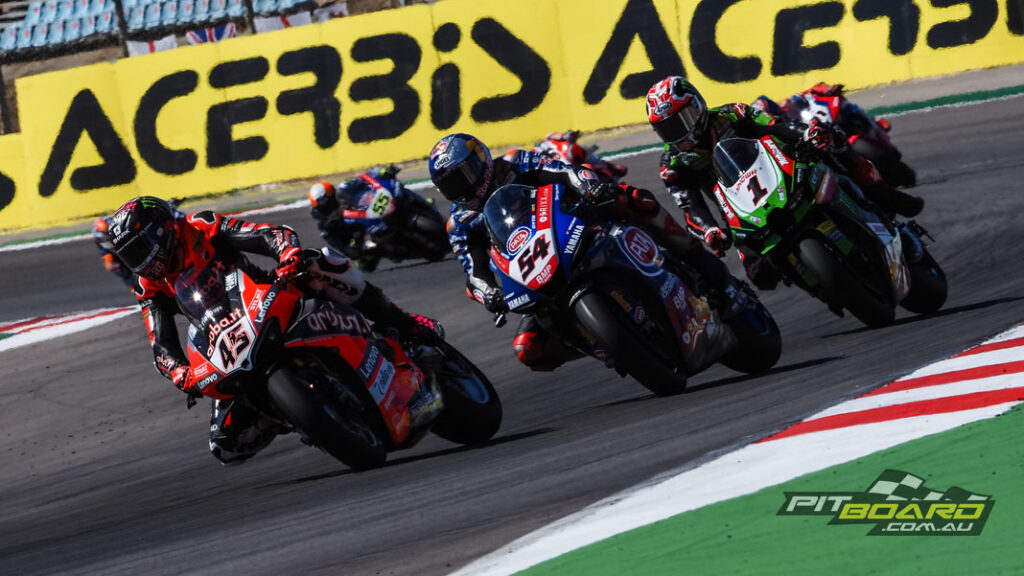
Toprak Razgatlioglu (Pata Yamaha with Brixx WorldSBK) raced to victory, his first in WorldSBK at the Algarve circuit in Portimao and his 11th of the year, whilst Jonathan Rea (Kawasaki Racing Team WorldSBK) crashed at speed from the lead of the race at turn 15. 
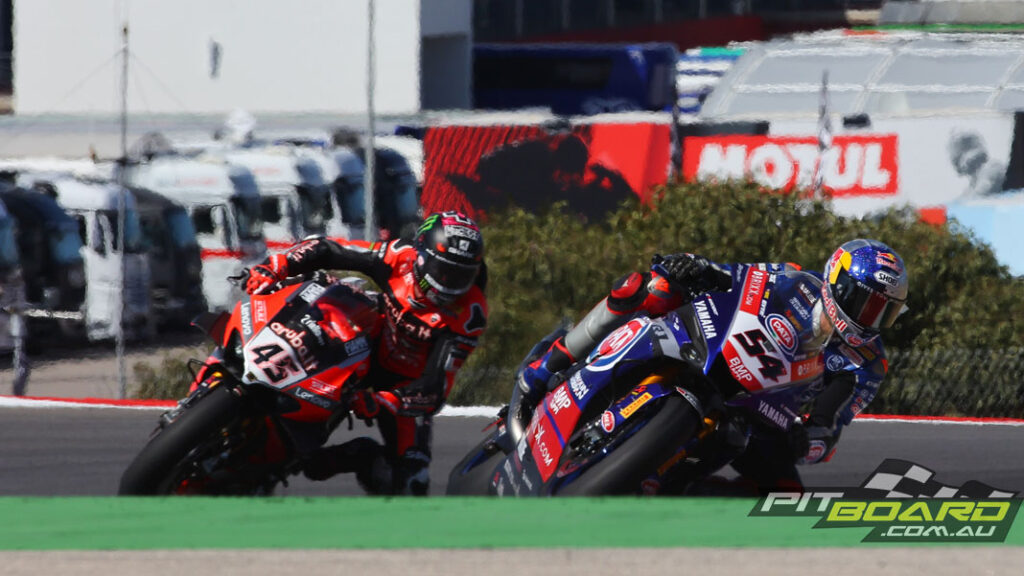
In what was one of the most intense opening five laps of the season, neither Razgatlioglu or Rea wanted to give an inch as they duelled hard. On lap two, Rea put a superb pass on Razgatlioglu at turn 11 but Toprak held on at turn 12, firing his Yamaha back through. Rea tried again at turn 13 but ran slightly wide, whilst Razgatlioglu scythed back through, colliding with Rea. The fight continued as Rea had a huge moment at turn one on lap five before getting under Razgatlioglu again at turn 11, whilst race leader Scott Redding ran wide at turn 13, with Rea coming back through to the lead. Then, disaster, as Rea tucked the front at turn 15, his Kawasaki ZX-10 RR barrelling through the gravel.

At the front, Scott Redding was leading the way until Toprak took back the lead at turn 1 with just less than four laps to go, and whilst Redding continued to try and retaliate, he couldn’t keep Toprak at bay. Razgatlioglu delivered Yamaha a first Portimao win since Marco Melandri in 2011. 

The fight for third was an ongoing affair throughout the 20-lap encounter with Leon Haslam (Team HRC) starting from third place holding onto that position until around the mid-way point of the race before he dropped positions, with Alvaro Bautista (Team HRC) working his way up to third place on lap 12. There was plenty of action between the six riders in contention for a podium, with Andrea Locatelli (Pata Yamaha with Brixx WorldSBK), Haslam and Michael Ruben Rinaldi (Aruba.it Racing – Ducati) all running wide at turn one at various points of the race.
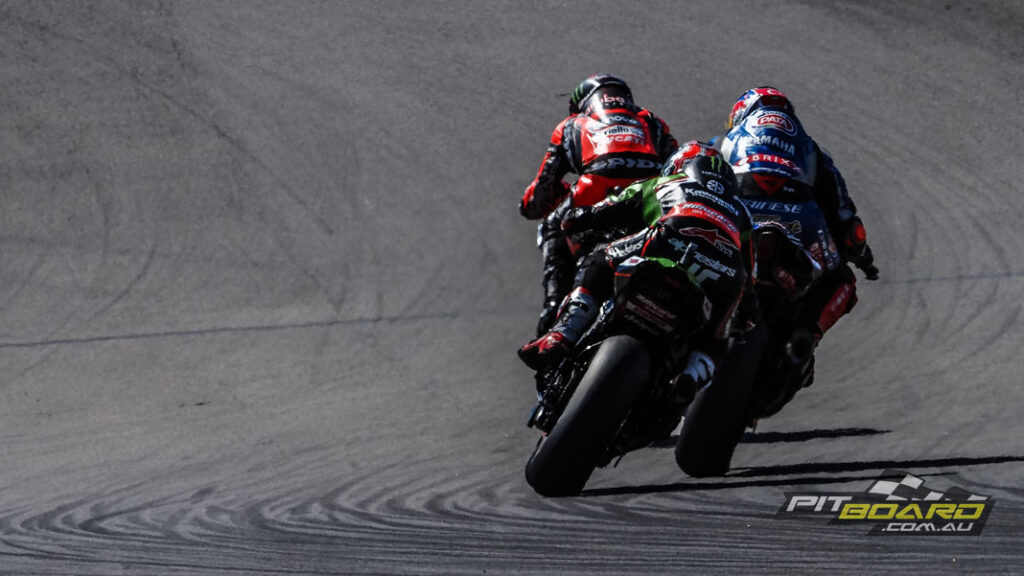
As the race progressed, Bautista was unable to pull out a gap to the chasing pack with Loris Baz (Team GoEleven) and Michael van der Mark (BMW Motorrad WorldSBK Team) chasing Bautista, Baz making the move at turn one before van der Mark and Locatelli, still chasing third, made contact at turn five with Locatelli retiring and van der Mark bringing his bike back to the pits; the incident will be investigated after the race by the FIM WorldSBK stewards. With the pair out of contention for the podium, Baz and Bautista battled for third place with the Spaniard coming out on top. At turn 15 on the final lap, Bautista crashed out of the race with Baz inheriting third place, his first podium since his WorldSBK return.

Rinaldi finished the race in fourth place after the incredible battle for third place, with Haslam eventually coming home in fifth place after starting from the front row. Garrett Gerloff (GRT Yamaha WorldSBK Team) claimed a solid sixth place, just three tenths behind Haslam in fifth place.

Axel Bassani (Motocorsa Racing) continued his strong rookie campaign with seventh place ahead of Argentinean star Leandro Mercado (MIE Racing Honda) claiming eighth place – his best result of the 2021 campaign. Eugene Laverty (BMW Motorrad WorldSBK Team) battled up for ninth with Christophe Ponsson (Gil Motor Sport-Yamaha) claiming tenthh.

Isaac Viñales (Orelac Racing VerdNatura) missed out on the top ten by just over half-a-second but came home in 11th place, just ahead of Italian Samuele Cavalieri (Barni Racing Team); Cavalieri just a second behind Viñales. 2014 Moto2™ World Champion Tito Rabat (Kawasaki Puccetti Racing) scored points on his first WorldSBK race onboard Kawasaki machinery, with Kohta Nozane (GRT Yamaha WorldSBK Team) and Jonas Folger (Bonovo MGM Racing) rounding out the points.

Loris Cresson (OUTDO TPR Team Pedercini Racing) was the last of the classified riders with the Belgian missing out on a point by just 0.079s. Cresson’s teammate, Lachlan Epis, retired from the race after bringing his bike into the pits, while Gabriele Ruiu (B-Max Racing Team) was also a retirement from the race, along with Rea, Locatelli, van der Mark and Bautista.


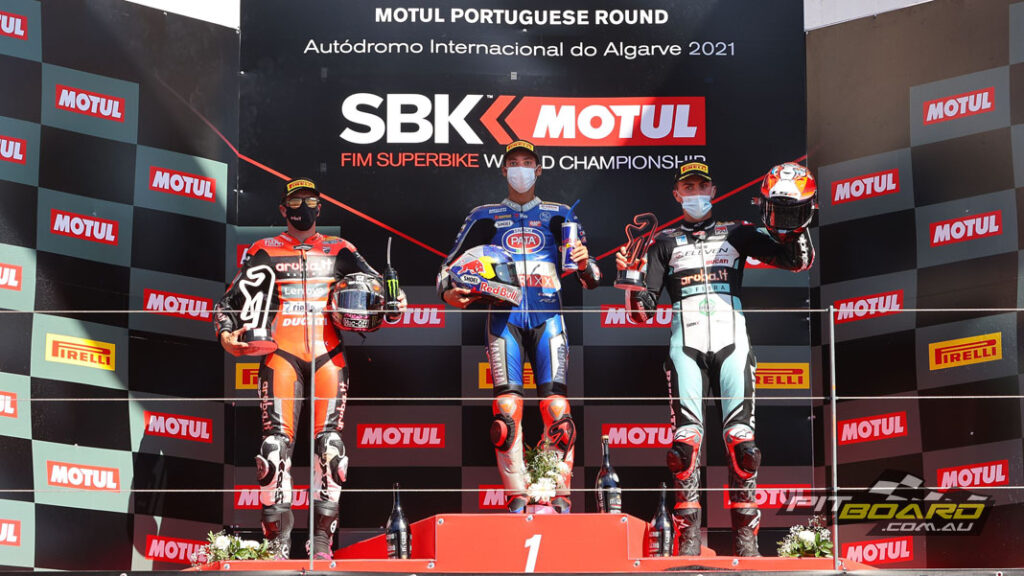
Race One Podium (Full Results Here)

1 Toprak Razgatlioglu (Pata Yamaha with Brixx WorldSBK)
2 Scott Redding (Aruba.it Racing – Ducati) +0.691s
3 Loris Baz (Team GoEleven) +10.628s


Tissot Sprint Race
Almost 3,000 days since their last win in 2013 (Nürburgring), BMW claimed WorldSBK victory as Michael van der Mark mastered tricky conditions at the Algarve circuit at Portugal’s Portimao to take the flag in the Tissot Superpole Sprint, while title contender Kawasaki’s Jonathan Rea crashed out. 

Toprak Razgatlioglu (Pata Yamaha with Brixx WorldSBK) got the better start of the xhampionship’s lead trio but soon found himself under pressure from Jonathan Rea (Kawasaki Racing Team WorldSBK) and Scott Redding (Aruba.it Racing – Ducati), with six-time world champion Rea taking the lead on the opening lap.
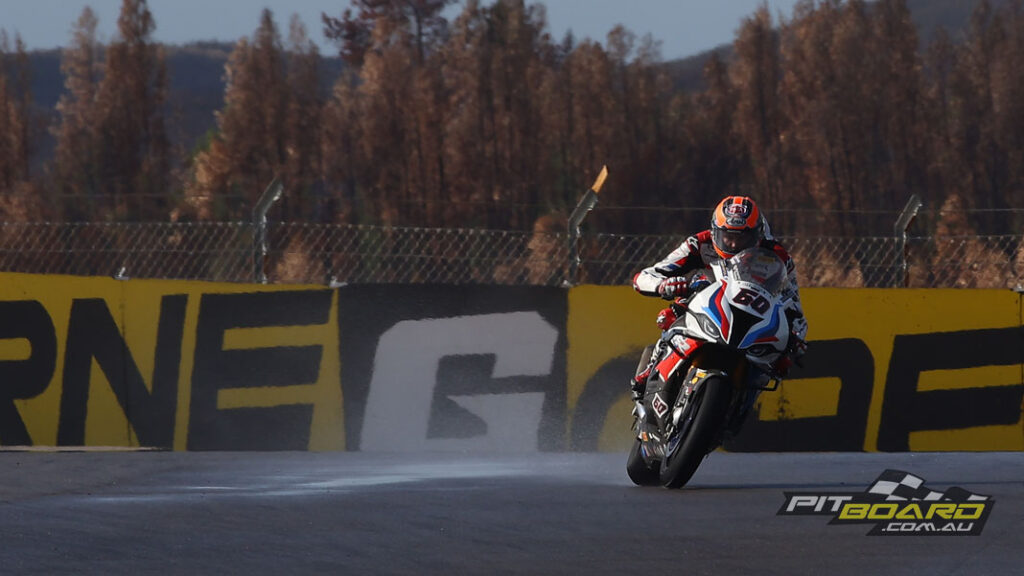
As the leaders approached turn 13, Rea lost the front of his machine and went off the track, the crash forcing him out of the race for the second consecutive race after his race one crash on Saturday, meaning Rea will start from tenth for race two Sunday afternoon.   Razgatlioglu and Redding were the lead duo, but things soon changed in the 10-lap race as Razgatlioglu dropped down through the order while Redding remained clear at the front.

\With all the drama out in front, van der Mark was working his way through the field and moved into the lead of the race on lap 4 after taking advantage of Redding running wide at the left-hander hairpin; BMW leading a race for the first time since Phillip Island 2020. He will therefore start race two from first on the grid, ahead of Redding in second.

Loris Baz (Team GoEleven) claimed third place after withstanding the challenge from Leon Haslam (Team HRC), although Haslam did briefly pass Baz before crashing out on lap 8. A second crash for Haslam on lap 9 meant he brought his machine back to the pits, promoting Andrea Locatelli (Pata Yamaha with Brixx WorldSBK) into fourth place.
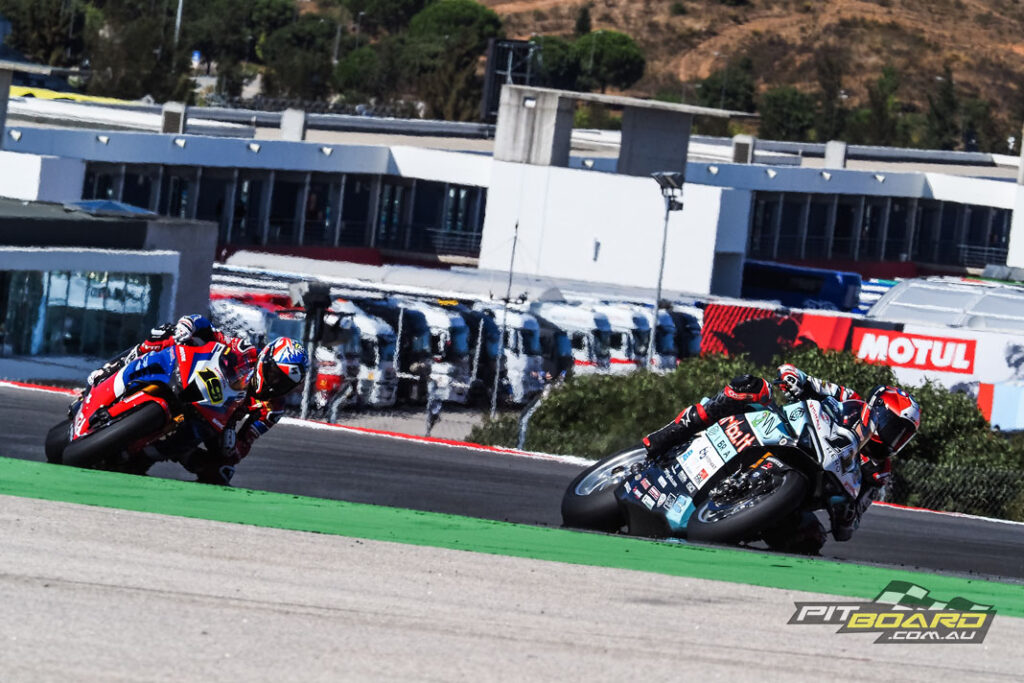
Alvaro Bautista (Team HRC) was another beneficiary from his teammate’s misfortune to move into fifth place, ahead of championship leader Razgatlioglu in sixth; the Turkish star able to limit his damage in the race after dropping down the order rapidly in the early stages, with Bautista and Razgatlioglu completing the second row alongside Locatelli.

Axel Bassani (Motocorsa Racing) continued his streak of top-ten finishes since his podium finish in Catalunya with seventh place, withstanding a charge from Garrett Gerloff (GRT Yamaha WorldSBK Team) with the American star just 0.068s behind Bassani. Irish rider Eugene Laverty (BMW Motorrad WorldSBK Team) was almost two seconds back from Gerloff with ninth as he starts from the third row.

Isaac Viñales (Orelac Racing VerdNatura) claimed the first top ten of his WorldSBK career as he finished in tenth place, as the top Kawasaki rider, two seconds clear of Leandro Mercado (MIE Racing Honda Team) in 11th; although both riders will start from their Superpole result as they missed out on a top-nine spot.


Tissot Superpole Podium (Full Results Here)

1 Michael van der Mark (BMW Motorrad WorldSBK Team)
2 Scott Redding (Aruba.it Racing – Ducati) +4.140s
3 Loris Baz (Team GoEleven) +5.479s


Race Two
The start was delayed due to a technical issue when the riders were lining up on the grid, with the delay meaning the race distanced was reduced one lap to 19 laps. Starting from tenth place, Jonathan Rea (Kawasaki Racing Team WorldSBK) was on the move from the get-go and was second by the end of the opener, while Toprak Razgatlioglu (Pata Yamaha with Brixx WorldSBK) moved into third place.
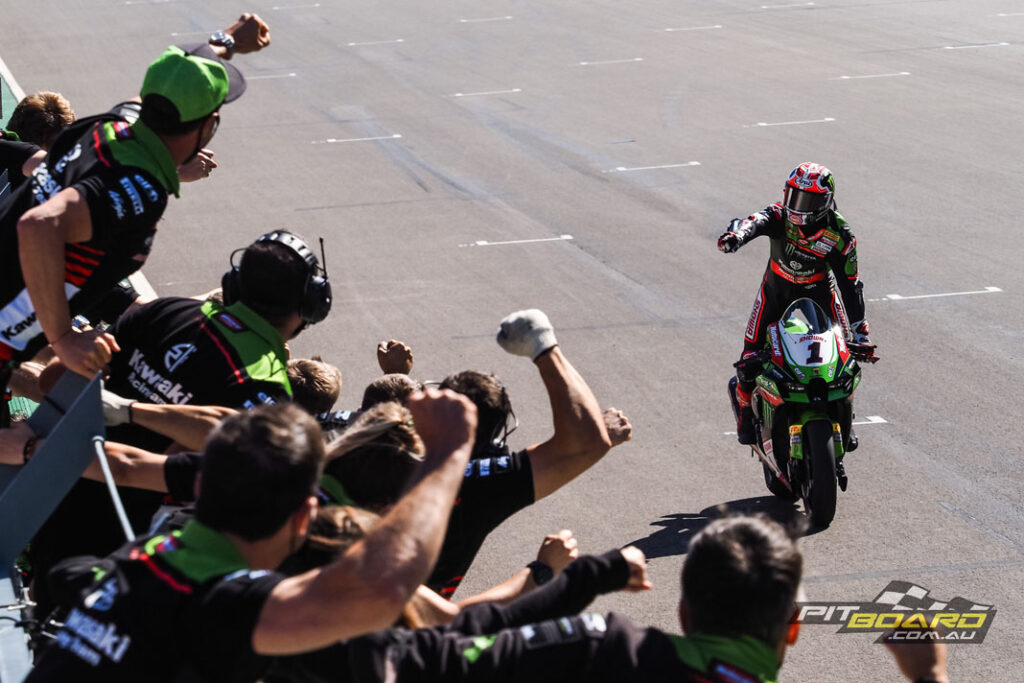
Rea made his move for the lead through the fast turn nine left-hander on lap two on Scott Redding (Aruba.it Racing – Ducati), relegating the British rider who had led from the start. At the start of lap two, Razgatlioglu passed Rea into turn one before the six-time world champion responded. The trio were battling throughout the opening laps, with both Razgatlioglu and Rea able to take advantage of Redding running wide at turns five and ten on the same lap.

Razgatlioglu made a move on Rea down the start-and-finish straight to move into the right-hander of turn one at the start of lap seven, before Rea responded at turn ten. At the end of lap ten, Razgatlioglu crashed at turn 15, the same place Rea did in race one, forcing the championship leader out of the race. Rea went on to take the 110th win and the 210th podium of his career, narrowing the gap in the championship to 24 points. Rea’s victory means both he and Razgatlioglu have scored 25 podiums this season, the first time it has happened in WorldSBK history. The top two in the Championship are also tied with 25 podiums and 11 wins each.
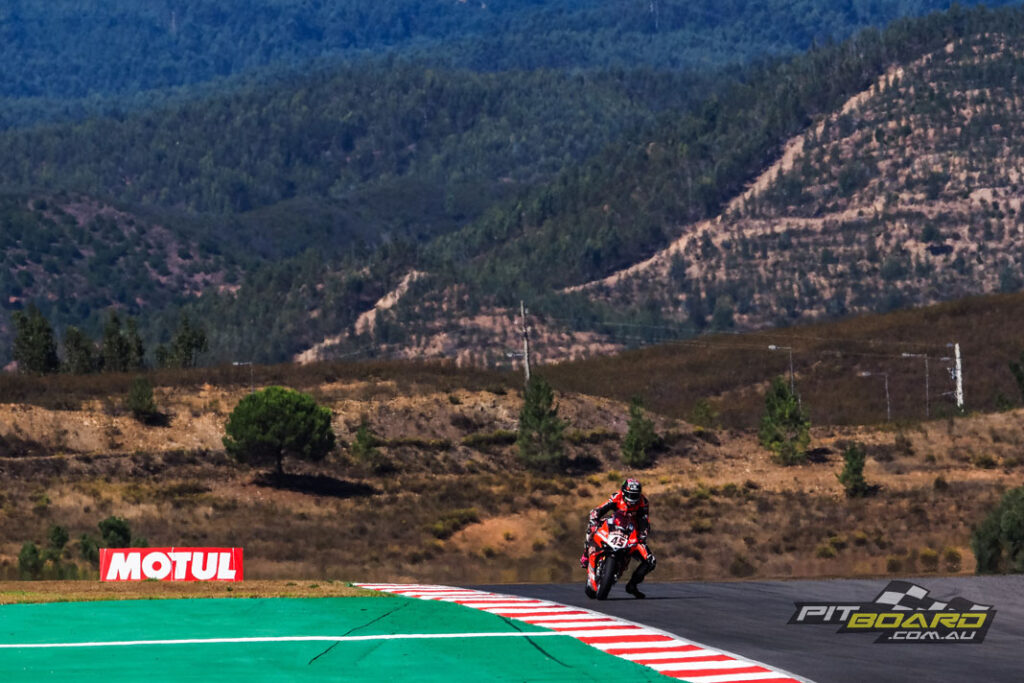
At the start of lap 13, Loris Baz (Team GoEleven) moved up into podium contention after his third-place start in race two after overtaking Andrea Locatelli (Pata Yamaha with Brixx WorldSBK) into turn one; Alvaro Bautista (Team HRC) had tried to pass both of them but Baz was wise to it, cutting back on the Spanish rider to re-take third place. Two laps later and Bautista looked to make a move through the opening couple of corners with Baz defending and keeping the position.

On lap 18, Bautista looked to make a move on Baz into the turn five hairpin, with Bautista running wide and Baz looking to reclaim the place. Through the exit of the corner, the pair made contact with Bautista coming off his bike and retiring from the race. Baz held on to cross the line in third place, while Locatelli came home in fourth place after withstanding a late surge from fellow Yamaha rider Garrett Gerloff (GRT Yamaha WorldSBK Team) in fifth place. After the race, Baz was sanctioned with a one place position drop, demoting him to fourth place and promoting Locatelli to third; the Italian’s fourth podium of his rookie campaign.

Michael van der Mark (BMW Motorrad WorldSBK Team) was sixth after starting from first place, five seconds clear of Michael Ruben Rinaldi (Aruba.it Racing – Ducati) with the Italian suffering from a right ankle sprain and contusion and a right hip contusion following his Tissot Superpole Race crash. He battled with Leon Haslam (Team HRC) throughout the race with the pair separated by just three tenths at the end of the 19-lap encounter.

Italian rookie Axel Bassani (Motocorsa Racing) continued his strong form with ninth place, after battling with Rea during the open lap of the race, eventually finishing two tenths clear of Eugene Laverty (BMW Motorrad WorldSBK Team) as he scored points again as he continues to stand in for Tom Sykes.
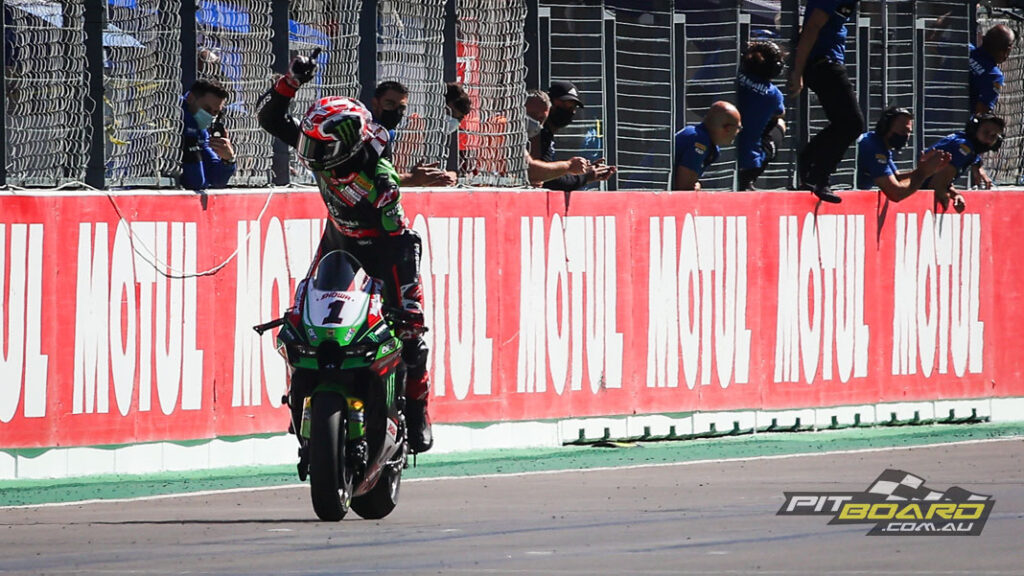
Laverty finished five seconds clear of Leandro Mercado (MIE Racing Honda Team) in 11th place, who was also clear of Spanish rider Isaac Viñales (Orelac Racing VerdNatura) in 12th place. Japanese rookie Kohta Nozane (GRT Yamaha WorldSBK Team) was 13th, just over a second behind Viñales, with Christophe Ponsson (Gil Motor Sport-Yamaha) and Jonas Folger (Bonovo MGM Action) rounding out the points. Samuele Cavalieri (Barni Racing Team) was the last of the classified runners in 16th place.

Loris Cresson (OUTDO TPR Team Pedercini Racing) was the first retirement of the race after a crash at the start of lap three, with the Belgian rookie taken to the medical centre for a check-up following the incident. Cresson was diagnosed with a concussion and a left knee injury and will be transported to Portimao Hospital for further assessments. Cresson’s teammate, Lachlan Epis, also retired from the race while Tito Rabat (Kawasaki Puccetti Racing) suffered from technical issues during the early running and brought his bike back to the pits. Wildcard Gabriele Ruiu (B-Max Racing Team) was also a retirement from race two after completing 10 laps.


Race Two Podium (Full Results Here)

1 Jonathan Rea (Kawasaki Racing Team WorldSBK)
2 Scott Redding (Aruba.it Racing – Ducati) +5.425s
3 Andrea Locatelli (Pata Yamaha with Brixx WorldSBK) +12.289s


Championship Standings After Round 11 (Full Standings Here)

1 Toprak Razgatlioglu (Pata Yamaha with Brixx WorldSBK) 478 points
2 Jonathan Rea (Kawasaki Racing Team WorldSBK) 454
3 Scott Redding (Aruba.it Racing – Ducati) 424

 

MotoGP: Maiden win for Bagnaia at MotorLand

0

He’s been close before, but Francesco Bagnaia (Ducati Lenovo Team) is now a MotoGP™ race winner. In a true all-time classic at the Gran Premio TISSOT de Aragon, the Italian went toe-to-toe with Marc Marquez (Repsol Honda Team) in a stunner of a duel, finding an answer for every attack as the eight-time World Champion tried, tried and tried again.

Repelling the final assault as the number 93 headed through but wide, Bagnaia was able to cross the line with just over half a second in hand to take his first premier class win in impeccable style. Marquez nevertheless got back on the podium for the second time this year and gave us an incredible show, with reigning Champion Joan Mir (Team Suzuki Ecstar) locking out the rostrum in third.

As the lights went out, polesitter Bagnaia got away well and held on for the holeshot, with teammate Jack Miller going in a bit deep at Turn 1 and that allowing Marc Marquez to grab P2 after a lightning start for the number 93. Aleix Espargaro (Aprilia Racing Team Gresini) was up to P4, with Championship leader Fabio Quartararo (Monster Energy Yamaha MotoGP) losing out and down to fifth 5th. Alex Marquez (LCR Honda Castrol) then crashed at Turn 5, rider ok.


As Bagnaia and Marc Marquez led the train away, Quartararo was struggling. Both Mir and Jorge Martin (Pramac Racing) passed the Frenchman next as he slipped towards the clutches of eighth place Brad Binder (Red Bull KTM Factory Racing), but nobody in the early stages was showing their cards, with only 2.2 seconds covering the top six.

Just outside that top six remained Quartararo, however. By now, the Frenchman had the rapid starting Iker Lecuona (Tech3 KTM Factory Racing) climbing all over him, and at the end of Lap 6, the number 27 was through. A couple of laps later, another KTM was ahead as Binder followed Lecuona after the Spaniard had despatched him too, and Quartararo was suddenly down to P9.


With eight laps gone, the cards were beginning to appear on the table. Bagnaia and Marquez were just over a second clear of Miller in third, and that advantage was soon up to nearly two with 13 to go. Miller headed wide at Turn 16 not long after too, allowing Aleix Espargaro and Mir to cut through. The reigning World Champion then managed to despatch the Aprilia to take over in third, but the gap to Pecco and Marquez was now nearly three and a half seconds.

To compound the gap, the pace was far from slowing. The two leaders were exchanging 1:48s lap after lap, with the rest in the 1:49s and below. They’d carved out a 4.3s lead over Mir and Aleix Espargaro with nine laps to go, but then it was into tyre life territory. Would that play a role? With five to go though, there was no change, with both riders still in the 1:48s… and it seemed it was going to the finish.

With four laps left, the pressure from Marquez was ramping up. Getting closer and closer until he was glued on, a lap later the first move finally came. The Honda rider went for a lunge into Turn 5, but he was in a little hot and slightly wide, Pecco replying unflustered to get back into the lead. So Marquez next shoved his RC213V up the inside at Turn 15, but again, the Italian got the cutback and held P1. Two down, how many to go?

On the penultimate lap, another. An exact copy and paste at Turn 5, Marquez again lunged late and again got a quick reply. The exact same thing happened at Turn 15 too, and again, Bagnaia carved back past. And so it was going down to some final lap fireworks…

This time, Marquez tried his luck at Turn 1, but that didn’t stick either. So, of course, Turn 5 saw another lunge for the third lap in a row, with the exact same result. That made six attempts from the number 93, each of which had been on to try but each of which had been greeted with a swift reply.

Marquez is Marquez though, so a seventh attempt then came at Turn 12. The number 93 got a great run out of his own namesake Marc Marquez Corner and was up the inside at the downhill left-hander, not a move he’d tried yet but ultimately one that wasn’t going to work either. Struggling to get it hooked up to the apex, Marquez was wide and onto the green, and Pecco needed no second invitation to sweep back past, keep it pinned and finally gain a few metres of breathing space.


From there the Italian made no mistake and crossed the line to complete a perfect weekend: pole position to maiden MotoGP™ victory, the eighth winner of 2021, defeating Marc Marquez on his home turf. His victory is also the 250th for Italy in the premier class, adding Francesco Bagnaia next to a little chapter of a rich history. Emotional in parc ferme, Bagnaia was just sublime on Sunday at Aragon.

Marquez threw absolutely everything at it as he sought that seventh win at MotorLand though, coming up just six tenths short. Still, it’s another podium and a leading role in an all-time classic, as well 20 points to add to his tally – and he’ll likely sleep rather well knowing he left it all out there, seven times.

Behind, Mir kept it tidy in third to take his fifth rostrum of 2021, in some space alone as he escaped Aleix Espargaro but couldn’t get onto terms with Bagnaia and Marquez. Aleix Espargaro’s P4 is another excellent ride from the Spaniard though, and he’s the top Independent Team rider. Miller couldn’t recover ground later on and finished a lonely fifth.

Reigning Moto2™ World Champion Enea Bastianini (Avintia Esponsorama) claims sixth for his best premier class result, putting the cherry on top of an impressive weekend. The rookie beat Binder by just 0.3s, and both escaped Quartararo by a good margin. A tricky day at the office for the World Championship leader and his second worst result of the season sees his lead cut, but it’s still a healthy 53 points with five races to go.

Martin took P9 less than a tenth behind Quartararo too, with Takaaki Nakagami (LCR Honda Idemitsu) 10th in the same pack as Bastianini, an earlier sparring partner, was able to break away from the Japanese rider. Lecuona made a mistake with a handful of laps to go that saw the Spaniard slip outside the top 10, but it was nevertheless a great ride from the 21-year-old and a stunning early charge.

Alex Rins (Team Suzuki Ecstar) pocketed P12 from P20 on the grid, gaining some ground, and it was a quieter day for Pol Espargaro (Repsol Honda Team) in P13, just ahead of Miguel Oliveira (Red Bull KTM Factory Racing) and 15th place Danilo Petrucci (Tech3 KTM Factory Racing).

Cal Crutchlow (Monster Energy Yamaha MotoGP) and Johann Zarco (Pramac Racing) were P16 and P17 respectively, with Maverick Viñales taking P18 on his Aprilia Racing Team Gresini debut. Valentino Rossi (Petronas Yamaha SRT) and Luca Marini (Sky VR46 Avintia) were the final finishers, with Jake Dixon (Petronas Yamaha SRT) joining Alex Marquez in the DNFs, crashing out on Lap 2 and rider ok.

So, a magnificent MotorLand battle sees Bagnaia finally claim that illustrious first MotoGP™ win. Next up: his home race at Misano. Remember that time he disappeared in the lead and then crashed? The Italian will be looking for a replay of the first half, and has never seemed less likely to recreate the second… save the date as MotoGP™ gets ready to take on the Riviera di Rimini.

Francesco Bagnaia: “A lot of emotion today. I’m so happy. We worked a lot to achieve this result, every time we were close, something happened and this dream to take my first victory, every time it was far. So to win today is a great liberation. I’m so happy, I have to say thanks to all the team, my family, my fantastic girlfriend, who are with me every day. It’s difficult to say something now, but it was not easy. I knew it wasn’t easy to stay in front of Marc at this track. His body isn’t at 100% but I think today with the hunger to win he was very, very competitive, and… I just tried to do my best and finish first. It’s a dream come true.”


MotoGP podium (Full Results Here)

1 Francesco Bagnaia – Ducati Lenovo Team – Ducati – 41:44.422
2 Marc Marquez – Repsol Honda Team – Honda – +0.673
3 Joan Mir – Team Suzuki Ecstar – Suzuki – +3.911


Moto2
Raul Fernandez (Red Bull KTM Ajo) pulled another sensational win out of the hat at Aragon, despite a crash at Silverstone leaving him on the back foot and a crash cycling for which he needed surgery on his hand just before the race weekend. Nevertheless, he dominated to equal Marc Marquez’ record of five wins as a Moto2™ rookie, with teammate and Championship leader Remy Gardner taking second. With that, Red Bull KTM Ajo wrapped up the Teams’ Championship, and the win was also their hundredth too. Augusto Fernandez (Elf Marc VDS Racing Team) completed the podium for another rostrum finish as he shows more good 2021 form, storming through from 12th on the grid.

Off the line it was Sam Lowes (Elf Marc VDS Racing Team) who held firm from pole from Gardner and Raul Fernandez, opening up an advantage of 0.6 on the opening lap as Raul Fernandez then passed title rival Gardner for second at Turn 12. Just behind, Ai Ogura (Idemitsu Honda Team Asia) grabbed P4 from Hector Garzo (FlexBox HP 40). The fastest lap of the race on Lap 2 for Raul Fernandez saw him cut Lowes’ lead to just 0.2, with Gardner sitting twice that down on his teammate, in third.

The number 25 then decided to attack for the lead at the beginning of Lap 4, with Gardner exchanging P3 with Ogura just behind. The Australian was having a scrappy opening handful of laps, wide at Turn 12 and once again conceding P3 to Ogura. Soon after, Garzo was also ahead of Gardner. It was a fascinating scrap the Aussie found himself in, but in getting caught up with the likes of Ogura and Garzo – who crashed at Turn 8 on Lap 5 – the gap to Lowes and Fernandez was up to 1.9s. By 10 laps down, Raul Fernandez was still holding Lowes at bay by just over a second and Gardner was over three seconds down on them, with Jorge Navarro (+EGO Speed Up) and Aron Canet (Kipin Energy Aspar Team) in hot pursuit.

On Lap 12, the first drama for a frontrunner: Marco Bezzecchi’s (Sky Racing Team VR46) quiet weekend came to a premature end at Turn 8, putting a dent in his standings.  And then, after seeing Raul Fernandez stretch his lead to nearly one and a half seconds, a gift was handed to both Red Bull KTM Ajo riders as Lowes was the next to slide out. Rider ok, the Brit stacked it at Turn 7 with nine laps to go, leaving Raul Fernandez with a huge, six-second lead over Gardner. Despite the pain barrier, the number 25 was unstoppable. Keeping that gap to the end, Raul Fernandez took his fifth win to take back to the top step in style, with the deficit to Gardner in the Championship down to 39 points as they swept the Teams’ title too.

In even more good news for Aki Ajo, future Red Bull KTM Ajo rider Augusto Fernandez took the final place on the podium. After starting 12th the Spaniard make good progress to slice his way up to the fight for the rostrum, with Navarro his final obstacle. The two had a good duel before the number 37 was able to just pull away to take that third.

Navarro nevertheless took another strong result in fourth, with Canet finishing three seconds down on the rostrum fight in P5. P6 went the way of Fabio Di Giannantonio (Federal Oil Gresini Moto2), as newly crowned Moto2™ European Champion Fermin Aldeguer (+EGO Speed Up) claimed a stunning P7 – his best yet despite already having made quite an impression. Ogura faded slightly and took P8, with fellow rookie Tony Arbolino (Liqui Moly Intact GP) finishing P9 in a much improved race day for the Italian.

The experienced Simone Corsi (MV Agusta Forward Racing) rounded out the top 10, the Italian beating Marcel Schrötter (Liqui Moly Intact GP), Marcos Ramirez (American Racing), Joe Roberts (Italtrans Racing Team), Cameron Beaubier (American Racing) and Celestino Vietti (Sky Racing Team VR46) as they locked out the remaining point scoring positions.

That’s a wrap on MotorLand as the paddock packs up and heads to Misano for another showdown next weekend. Can Bezzecchi and Lowes bounce back? Will Raul Fernandez show the same incredible form? Or will it be another win for Gardner as he enjoys that 39-point lead? We don’t have to wait long to find out!


Moto2 podium (Full Result Here)

1 Raul Fernandez – Red Bull KTM Ajo – Kalex – 39:49.990
2 Remy Gardner – Red Bull KTM Ajo – Kalex – +5.408
3 Augusto Fernandez – Elf Marc VDS Racing Team – Kalex – +6.824


Moto3
Moto3™ brought the serious drama at MotorLand, with three Championship contenders all finding bad luck or trouble on race day. The first was for Romano Fenati (Sterilgarda Max Racing Team) as he was forced into the gravel, then Championship leader Pedro Acosta (Red Bull KTM Ajo) crashed and, right as he seemed set to make huge gains, so did second overall Sergio Garcia (Gaviota GASGAS Aspar Team). But one contender held firm and avoided it all, with Dennis Foggia (Leopard Racing) pulling off a tactical masterclass to take his third win of the year and move back into third overall.

The Italian just defeated another stunner from Deniz Öncü (Red Bull KTM Tech3), the Turkish rider impressing once again but forced to wait for that first win. Completing the podium was Ayumu Sasaki (Red Bull KTM Tech3), the Japanese rider digging deep and taking an emotional second rostrum after a difficult few months of injury.

Darryn Binder (Petronas Sprinta Racing) kept the lead initially as the South African held on for the holeshot, but Garcia was quick to attack. As ever though, the moves came thick and fast and a leading freight train formed. Öncü took over at the front, with Acosta, Garcia and Binder shadowing in the early stages.

Drama hit on Lap 5 for Silverstone winner Fenati. Front row starter Gabriel Rodrigo (Indonesian Racing Gresini Moto3) suddenly crashed in front of the Italian, and he was forced to take avoiding action into the gravel – rejoining well down the order, a postcode off the points. There was also an early touch between Xavier Artigas (Leopard Racing) and Acosta but no harm done. Meanwhile Öncü rolled on at the front, able to stay ahead down the back straight too as a group of nine formed at the front followed by SIC58 Squadra Corse duo Lorenzo Fellon and Tatsuki Suzuki. 

After chipping away at it, they tagged onto the back to make it 11 riders fighting for the win, but it was a costly push for Fellon as the French rookie then got a Long Lap penalty for track limits. Taking it dropped him back in behind the chasing trio of Niccolo Antonelli (Avintia VR46 Academy), double 2020 winner at the track Jaume Masia (Red Bull KTM Ajo) and Stefano Nepa (BOE Owlride).

Antonelli and Nepa were next to tag on, but then drama whittled the group down again… and key drama. After a season of history making, Acosta made his first big race day error of the year, heading up the inside of Artigas and then losing it, skittling both out. And he couldn’t rejoin, leaving Garcia with an open goal…


Starting the final lap, Foggia led Öncü led the two GASGAS machines of Garcia and Izan Guevara (Gaviota GASGAS Aspar Team). Öncü then hit the front, the Turk digging in on the search for that elusive first victory, and even more drama soon hit just behind. Despite the huge chance to home in on Acosta, it just wasn’t to be. Garcia suddenly slid out as he fought to gain more ground, rider ok and able to rejoin but no points coming his way. 

Meanwhile, Öncü remained ahead and the Turk led heading onto the back straight – as he had a good few times during the race, able each time to keep it too. But this time, Foggia had the legs and the incredible straight-line speed of the Leopard Honda struck, the number 7 slicing past. Öncü tried to reply on the drag to the line and almost did, but he’s forced to settle for another second, just 0.041 off the win.

After a weekend of more muted timesheets at times from Sasaki, the Japanese rider played his cards to perfection on race day. Making moves through the group late on, the number 71 took his second Grand Prix podium by just 0.064, denying Guevara as the Spanish rookie was forced to wait for that first podium once again, just as at Silverstone.

Antonelli stormed the latter stages the come home in fifth, able to pull out a few tenths on compatriot Andrea Migno (Rivacold Snipers Team), who nevertheless bounced back after a tough-to-take technical DNF at Silverstone. Binder took seventh nearly a second further back, with Nepa half a second behind him. Suzuki lost out to the Italian by 0.101 as he took ninth, with Masia completing the top ten a couple of seconds off the front group, not finding his 2020 MotorLand magic this time around.

Ryusei Yamanaka (CarXpert PrüstelGP) took P11 with a little breathing space ahead of Adrian Fernandez (Sterilgarda Max Racing Team), with Syarifuddin Azman (Petronas Sprinta Racing) only a tenth and a half off the number 31 by the flag. No mean feat, and the Malaysian impressively scores points on his Grand Prix debut.

Rather stunningly, behind him came Fenati. The veteran Italian dug in to try and gain ground back after being forced wide, and gain ground he did. Making up the gap to the next riders, passing them, and then rinsing and repeating, the number 55 took 2 points for 14th. Riccardo Rossi (BOE Owlride) just pipped Kaito Toba (CIP Green Power) to the final point, with a late crash seeing Jeremy Alcoba (Indonesian Racing Gresini Moto3) and Fellon both fail to make the flag.


Moto3™ podium (Full Results Here)

1 Dennis Foggia – Leopard Racing – Honda – 37.53.710
2 Deniz Öncü – Red Bull KTM Tech3 – KTM – +0.041
3 Ayumu Sasaki – Red Bull KTM Tech3 – KTM – +0.644


WorldSBK: Race Reports From RD10 At Jerez

0

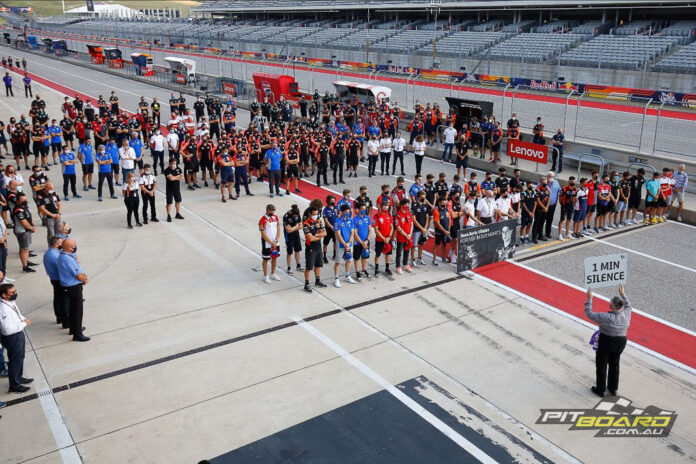
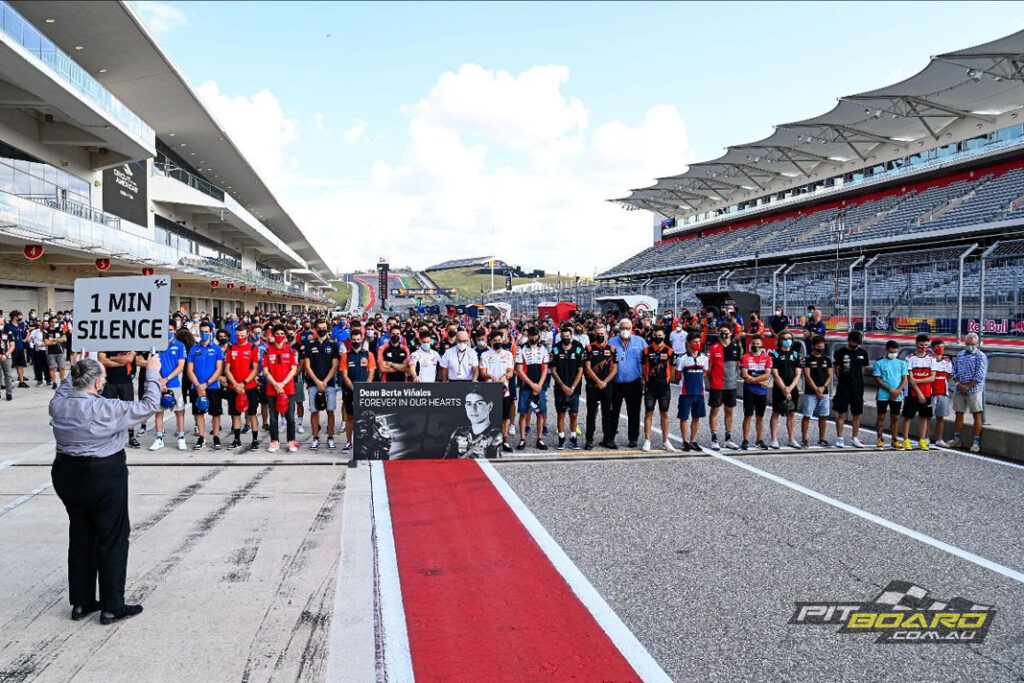
The 2021 MOTUL FIM Superbike World Championship’s tenth round of the season at the Circuito de Jerez – Angel Nieto saw Toprak Razgatlioglu claim pole for Sunday racing at the MOTUL Spanish round following a sad day after the passing of Dean Berta Viñales.

After the sad passing of Dean Berta Viñales following an accident in the FIM Supersport 300 World Championship’s race one on Saturday, all Saturday track activity was cancelled. Sunday featured all of the WorldSBK races at Jerez. Having been knocked off his pole position perch last time out at Catalunya, Jonathan Rea (Kawasaki Racing Team WorldSBK) was eager to get back to the head of the field. However, it wouldn’t happen as Turkish delight was on order; Toprak Razgatlioglu (Pata Yamaha with Brixx WorldSBK) took a first pole of the year and a second of his career, as he powered to the head of the field.  Razgatlioglu has not taken a pole since Estoril 2020. 

With the WorldSBK field taking to the track under the beautiful Jerez sunshine, the first laps came in with some riders going straight to the Q tyre for their first attack on pole. Both title contenders Toprak Razgatlioglu and Jonathan Rea on the Q tyres, as well as Andrea Locatelli (Pata Yamaha with Brixx WorldSBK), who shadowed teammate Toprak on the first run.

However, it was formation flying as Alex Lowes (Kawasaki Racing Team WorldSBK), who is far from 100% fit as he nurses a right-hand injury, hit the front ahead of teammate Rea, both on the Q tyre, ahead of Locatelli, following the first flurry of action, both being the first riders into the sub-39 brackets with 1’38.7s, separated by just 0.005s. After the first run, Razgatlioglu was only tenth whilst there were surprises in the top ten, with Axel Bassani (Motocorsa Racing) and Isaac Viñales (Orelac Racing VerdNatura) in seventh and eighth, both just behind an in-form Alvaro Bautista (Team HRC), who was fifth having not used the Q tyre straight away, whilst Leandro Mercado (MIE Racing Honda Team) was also impressive, in and around the top ten.

Leaving it later to go out on track for a first run, Scott Redding (Aruba.it Racing – Ducati) was already up inside the top three, popping up to third after his first flying lap. Soon, he would be bumped back by teammate Michael Ruben Rinaldi, who set his first flying lap on the Q tyre after initially going out on race tyre rubber; Rinaldi went third and was, like the two Kawasaki ahead of him, in the 1’38s bracket. With further changes down the order, Razgatlioglu was down in 13th.


The final two minutes set the grid as Alex Lowes improved further, dropping the time down to a 1’38.539, just two tenths outside of Jonathan Rea’s 2019 pole record. However, after being more than two tenths of a second down after three sectors, Toprak Razgatlioglu pulled out the final sector of his life, blasting to the line and storming to his first pole position of the season by just 0.027s. More than a tenth of a second faster in the final sector than his rivals, Razgatlioglu was on fire to deliver Yamaha’s first pole of 2021, beating Lowes who starts second, whilst Jonathan Rea couldn’t take it to the two ahead of him and for a second round running, finishes third. The pole for Yamaha is the 40th in their WorldSBK history, the first since Estoril in 2020, also by Razgatlioglu.

Fourth place went to the first Ducati rider, Scott Redding, who was able to hold off a late charge from teammate Michael Ruben Rinaldi, with the Italian completing the top five. Rinaldi has looked like he’s been fast with race pace too, so a top five starting position could well see him come to the fore in the race. Andrea Locatelli completes the second row, more than half a second from his teammate’s time.

Heading up the third row of the grid in seventh place is super-sub Loris Baz (Team GoEleven), who was top Independent at the end of Superpole. The Frenchman gave Team GoEleven a return to the top ten, whilst in the middle of the third row, Leon Haslam (Team HRC) took top Honda honours, ahead of his in-form teammate Alvaro Bautista, who takes a first top nine since Misano, which is encouraging given his ability to charge through the field and pull a result out. Completing the top ten, Garrett Gerloff (GRT Yamaha WorldSBK Team) held off a late challenge from a sensational Leandro Mercado, who takes his best Superpole result since Losail 2019.

Other riders further down the order included Axel Bassani who was 12th whilst it was another tricky Superpole session for BMW, with Michael van der Mark (BMW Motorrad WorldSBK Team) heading up an all-BMW top five, with substitute teammate Eugene Laverty in 15th, both split by Jonas Folger (Bonovo MGM Racing). Isaac Viñales ended up 16th ahead of Kohta Nozane (GRT Yamaha WorldSBK Team), whilst Samuele Cavalieri (Barni Racing Team) was 18th. Marvin Fritz (IXS-YART Yamaha) was 19th, ahead of Andrea Mantovani (Vince64), Christophe Ponsson (Gil Motor Sport Yamaha), Loris Cresson (OUTDO TPR Team Pedercini Racing) and teammate Lachlan Epis.


Jerez Tissot Superpole Podium (Full Results Here)

1 Toprak Razgatlioglu (Pata Yamaha with Brixx WorldSBK) 1’38.512s
2 Alex Lowes (Kawasaki Racing Team WorldSBK) +0.027s
3 Jonathan Rea (Kawasaki Racing Team WorldSBK) +0.102s


Race One
A fierce battle for race one of the MOTUL FIM Superbike World Championship at the Circuito de Jerez – Angel Nieto with Toprak Razgatlioglu (Pata Yamaha with Brixx WorldSBK) claiming a hard-fought victory against Jonathan Rea (Kawasaki Racing Team WorldSBK) in the Spanish round after a difference in tyre strategies between the pair.

Razgatlioglu got the jump at the start to maintain his lead from pole position but soon found himself having to fend off the challenge from Jonathan Rea (Kawasaki Racing Team WorldSBK) on the opening lap, first at turn six before Rea made the move for the lead at turn eight with both riders on different rear tyres; Razgatlioglu on the SCX development solution and Rea on the SC0 development.

On the opening lap, Michael Ruben Rinaldi (Aruba.it Racing – Ducati) went deep into turn six and lost places to both Andrea Locatelli (Pata Yamaha with Brixx WorldSBK) and teammate Scott Redding, while Alex Lowes (Kawasaki Racing Team WorldSBK) also went wide. On lap five, Rinaldi crashed out of the race. Out in front, Rea was leading from Razgatlioglu but unable to pull out a gap as the Turkish rider consistently kept within half-a-second of Rea before closing the gap to around two tenths.

On lap seven, Razgatlioglu attempted to outbrake Rea into the turn six hairpin with the pair making contact and running wide, allowing Locatelli and Redding to close the gap even further although both riders were able to continue and keep their positions. The leading pair pulled away as Razgatlioglu set his sights on Rea once again.  On lap 14, Razgatlioglu made a move for the lead with a late braking move into turn one to take the lead, before Rea tried to respond  with the Turk holding on. Razgatlioglu was able to hold on for the final few laps of the 20-lap race to claim his first victory in Jerez.

As the closing stages of the 20-lap race approached, Redding started closing in on Locatelli in the battle with the fight raging on to the final lap of the race, Redding making a move into turn five with Locatelli unable to respond into the turn six left-hand hairpin to claim third place ahead of Locatelli.

Alvaro Bautista (Team HRC) claimed another top five finish for Honda after a strong result for the Spanish rider, although he was five seconds down on Locatelli. Loris Baz (Team GoEleven) was sixth after an impressive return for the Frenchman, with Baz replacing the recovery Chaz Davies in Jerez, claiming the top Independent rider spot in Race 1. Baz had a battle with Dutch rider Michael van der Mark (BMW Motorrad WorldSBK Team) for sixth place, with van der Mark finishing seventh.

In the closing stages, van der Mark had to withstand pressure from rookie Axel Bassani (Motocorsa Racing) with the Italian rider looking to make moves on the final lap. Lowes ended the race in ninth place after a battling race as he nursed his injured wrist, taking home a top ten finish despite the injury. American star Garrett Gerloff (GRT Yamaha WorldSBK Team) claimed tenth place after starting from the same position.

Leon Haslam (Team HRC) fell back during the race and ended up 11th, losing a position in the top ten late on in the race to Gerloff. Eugene Laverty (BMW Motorrad WorldSBK Team) took points from his first start since the UK Round at Donington Park with 12th place, as he stands in for Tom Sykes. Laverty had a battle throughout the race with Japanese rookie Kohta Nozane (GRT Yamaha WorldSBK Team) with experience paying dividends.

German rider Jonas Folger (Bonovo MGM Action) claimed points with 14th place, less than a second clear of Frenchman Christophe Ponsson (Gil Motor Sport-Yamaha) who took 15th. Marvin Fritz (IXS-YART Yamaha) missed out on points on his slightly modified endurance-specification Yamaha R1 with 16th place, ahead of Loris Cresson (OUTDO TPR Team Pedercini Racing) and wildcard Andrea Mantovani (Vince64) who rounded out the riders on the lead lap.

Samuele Cavalieri’s (Barni Racing Team) crashed out on lap five, while Lachlan Epis (OUTDO TPR Team Pedercini Racing) brought his Kawasaki ZX-10RR machine into the pits in the first half of the race, although he did return to the track after a few minutes in the box. Leandro ‘Tati’ Mercado (MIE Racing Honda Team) had a technical issue in the final third of the race, forcing the Argentinean rider out of the race, eventually classified four laps down. Isaac Viñales (Orelac Racing VerdNatura) opted to not take part in Sunday’s action following Saturday’s tragic events in WorldSSP300.


Jerez Race One Podium (Full Results Here)

1 Toprak Razgatlioglu (Pata Yamaha with Brixx WorldSBK)
2 Jonathan Rea (Kawasaki Racing Team WorldSBK) +1.225s
3 Scott Redding (Aruba.it Racing – Ducati) +2.791s


Race Two
A familiar story to race one, with the same outcome but a different opponent for Toprak Razgatlioglu (Pata Yamaha with Brixx WorldSBK) as he claimed his second MOTUL FIM Superbike World Championship victory of the day at the Circuito de Jerez – Angel Nieto for the Motul Spanish Round after a late-race battle with Scott Redding (Aruba.it Racing – Ducati).

Repeating his start from race tone, Razgatlioglu got a good start to lead into turn one from Jonathan Rea (Kawasaki Racing Team WorldSBK) and, while Rea was able to challenge into turn six on the opener, the Turkish star was away and found himself with Ducatis in pursuit. While Razgatlioglu was able to hold his lead, both Michael Ruben Rinaldi (Aruba.it Racing – Ducati),  and Scott Redding (Aruba.it Racing – Ducati) were closing in. On lap six, Rinaldi ran wide at turn six which almost allowed Redding through, but Rinaldi was able to hold on to second place until turn 13, when Redding made the move for second.

While Redding was putting pressure on, Razgatlioglu held on until lap 17 when Redding passed Razgatlioglu for the lead but just one lap later Razgatlioglu responded, making a move at turn 13 to take control. Redding kept the pressure on Razgatlioglu throughout the final two laps, but the Turkish star held on to claim his second victory of the day in Jerez, and his tenth of the season while Redding claimed his 30th WorldSBK podium.

With Razgatlioglu, Redding and Rinaldi in front, Rea found himself losing ground and having to defend from Andrea Locatelli (Pata Yamaha with Brixx WorldSBK), Alvaro Bautista (Team HRC) and Axel Bassani (Motocorsa Racing) to defend fourth place. On lap 7, Locatelli passed Rea at the final corner to move into fourth place.

Just a lap later, Bautista passed Rea while Italian rookie Bassani tried to follow him through but made contact with Rea, with both able to resume the race without losing time or positions. While Bautista was able to pull away, Bassani kept the pressure on Rea as he looked to pass the six-time champion. Eventually Rea was able to pull away from Bassani and soon found himself back into fifth place after passing Rinaldi.

Bautista was able to make a move on Locatelli for third after passing Rinaldi as he claimed his second podium in four races and his fourth consecutive top-five finish, the first time he has managed that feat since joining Honda. Locatelli came home in fourth place, a very familiar position for the Italian rookie, over a second clear of Rea. With Razgatlioglu taking victory and Rea finishing fifth, the championship lead now stands at 20 points in Razgatlioglu’s favour.

The top six were clear of Rinaldi at the end of the race with Bassani claiming sixth place as the Italian continues his strong rookie season, finishing ahead of the factory Ducati of Rinaldi. Michael van der Mark (BMW Motorrad WorldSBK Team) finished in eighth place and closed in on Rinaldi in the closing stages with just a second behind Rinaldi.

Loris Baz’s (Team GoEleven) WorldSBK continued with another top-nine finish as the Frenchman finished in ninth place, just two tenths away from van der Mark. American star Garrett Gerloff (GRT Yamaha WorldSBK Team) claimed another tenth place finish ahead of Eugene Laverty (BMW Motorrad WorldSBK Team) claimed 11th place in his first round back for three months, holding off Leon Haslam (Team HRC) by just 0.042s at the end.

Jonas Folger (Bonovo MGM Action)  finished in 13th place, half-a-second back from Haslam. Samuele Cavalieri (Barni Racing Team) claimed more points following his return to the Barni Racing outfit while Leandro Mercado (MIE Racing Honda Team) claimed the final points place despite a crash on the second lap.

Wildcard Marvin Fritz (IXS-YART Yamaha) was in 16th place after his second wildcard appearance of the season despite a crash on lap 7 while Andrea Mantovani (Vince64) was in 17th place rounded out the riders on the lead lap. Like in Race 1, Lachlan Epis (OUTDO TPR Team Pedercini Racing) finished three laps down after spending a substantial amount of time in the pits.


Jerez Race Two Podium (Full Results Here)

1 Toprak Razgatlioglu (Pata Yamaha with Brixx WorldSBK)
2 Scott Redding (Aruba.it Racing – Ducati)
3 Alvaro Bautista (Team HRC)


Championship Point Score After Jerez RD10 (Full Standings Here)

1 Toprak Razgatlioglu (Pata Yamaha with Brixx WorldSBK) 449
2 Jonathan Rea (Kawasaki Racing Team WorldSBK) 429
3 Scott Redding (Aruba.it Racing – Ducati) 375


Racer Test: Ex-Eugene Laverty Aprilia RSW250

0

The chance to ride a real deal 250 Grand Prix World Championship bike is the stuff dreams are made of. I grew up obsessed by 250GP racing. In my teens in the 1990s I knew every rider, every race number, had the posters on my bedroom wall and all of the races taped on videotape!

As soon as I got my Learners, I was on the road on an old RZ250FN, followed by a few TZR250s before I started road racing on RGV250s in 1995. Even my RGV racebike was painted the same colors as the Ralf Waldman HB 250. Riding the RGV proddie, I dreamed of one day being a 250 GP rider…


Check out all of our racer tests here…


Fast forward 22 years and I find myself about to ride a RSW250 Aprilia thanks to the owner, Harry, who kindly offered us a spin. Things have changed with my 250 GP aspirations, though, not only am I over 40, I also weigh more than the bike! Now that is funny! No lap records, then. At least that is my excuse…

This Aprilia RSW250 is an ex-Eugene Laverty GP machine raced in 2008, simply a stunning bike!

About the bike. It is trick. It is expensive. It is rare and absolutely stunning. The peak of two-stroke development is right here under the fairings… This is the Aprilia Racing RSW250 ridden by Eugene Laverty in the 2008 250 Grand Prix World Championship. It is the real deal and very, very rare, not to mention priceless. The swingarm alone is worth are fifty grand!

The RSW250 was made by Aprilia from 1991 to 2007. It has been ridden to world titles by the likes of Max Biaggi, Valentino Rossi, Marco Melandri, and Jorge Lorenzo and has won countless memorable races. With just over 100-horsepower at the wheel and weighing in at less than 200-pounds the power-to-weight is over one to one.

The factory carbon-fibre swingarm is worth an easy $20,000! Imagine one of these on a street bike.

The frame is hand made aluminum, as is the fuel tank. The seat unit and rear hump is a complete A kit part only for factory teams, all carbon-fibre monocoque, and the wheels and swingarm are carbon-fibre also. The engine is cast magnesium and every single nut, bolt, axle and washer is titanium. The massive ram air system and airbox is also carbon-fiber, as is all of the bodywork. It truly is a work of art and at this level of racing, you can see where a million bucks goes…

The 249cc 90-degree V-twin two-stroke revs to over 12,000rpm and is the absolute trickest little engine I’ve seen. The opportunity to actually get in there and have a good look was heaven, as these bikes were always so guarded when they were competing of course.

In all its glory – The Aprilia RSW250 with 42mm VHSE flat slide magnesium carburettors are rare and expensive.

What is immediately apparent is the size of the engine compared to a production 250 two-stroke. There is nothing there that is not needed and everything has been developed and refined to be absolutely as compact and lightweight as possible.

The clutch is tiny, as is the gearbox and cases. The other side has the small magneto flywheel and ignition pickup. The expansion chambers are gorgeous – titanium with carbon-fiber mufflers, and the airbox and carburetors are so, so mind blowingly trick. Just look at those pictures and drool!

This is actually a tiny programmable quickshifter. Still compact even by todays standards!

The wheels are factory items that simply cannot be bought. Ever. Brakes are factory spec monobloc radial-mount calipers with cast-iron rotors. Carbon-fiber is available for some situations also. Ohlins factory suspension is at both ends. Rumor has it the forks are worth 20 grand each. The triple-clamps are titanium and the handlebars carbon-fiber. Everything is tiny, compact, almost under-engineered.

What may seem like a simple two-stroke is far from it. Aside from the technology in the tuning of the porting, combustion chamber, crankcases and expansion chambers, there is a complex fueling and powervalve system along with full data logging and even traction control. Yes, you read that right.

Factory spec Brembo brakes offer incredible performance, when you consider just how light this machine is.

The datalogger system, which is the factory Aprilia one that came with a staff member for the teams, provides all aspects of data from braking to suspension and ignition and jetting. The software tells the team what jetting to change after each session, based on the live atmospheric conditions and data from the previous run.

The traction control system is an ignition curve based one that uses an algorithm to determine rear wheel slip based on throttle position, wheel speed, gear and so forth, similar to what is now used in modern motocross and enduro two-stroke factory race bikes.

The factory Aprilia dash is actually extremely high tech, with the RSW250 including traction control and full telemetry.

Everything on the RSW is hand-made and a work of art. From any angle, it looks amazing. Actually, I have blown up one of the photos we took and I have it as a poster above my workbench in my garage. This bike makes me feel young I guess… All of those dreams I had as a teenager about racing in 250…


THE RIDE
Nerves. Adrenaline. Excitement. Those three things that make you feel just a little bit sick in the stomach, well, they are all off the chart as Harry warms the bike up (see the video, it sounds so awesome).

I close my visor as he rolls the bike out into pit lane. If I’m riding a 250 GP bike, I’m walking out to it like a boss, visor down and cameraman snapping away! Ha!

A nerve racking moment as Jeff jumped onto the RSW250 for the first time around SMSP.

I hop on the bike and immediately think, ‘How the hell and I going to fit in this’… I think back to when I was 19 and skinny and I just squash myself into Laverty’s ergonomics. The nerves settle a little as I blip the throttle and get the engine up to temperature. My old two-stroke days are flooding back to me and there is a crowd gathering around the bike. It is loud. Very loud…

A huge amount of revs and clutch slipping, along with a lot of leg paddling and I’m off up pit lane. I just ride straight past the person checking wristbands, I’m not stopping again! I short-shift in the lower top-end via the ultra-slick factory quickshifter and do my usual checks into turn two, like feeling the front and rear brakes and generally getting into a relaxed riding position.

From every angle, the RSW250 is just a crazy looking bike. Huge amounts of development went into making this bike as competitive as it was.

The bike was straight off the warmers and what blows me away is I’m scraping my whole leg in the second corner from pit lane and carrying more corner speed than I have on any bike for years, and it is my out lap! When you ride road production bikes for so long, it is easy to forget how a proper handling thoroughbred feels and there is no comparison to any street going bike at all, not even close. The RSW is beyond telepathic. It’s an extension of my body – more than a bike; well that is how it is making me feel.

Watching GP rider’s highside for a few decades is in the back of my mind exiting the turns on my out lap but I’m soon surprised at the amazing tractability and drive of the RSW. It is jetted a little on the conservative side, so hasn’t got that razor’s-edge sharpness to the throttle, but still it is on song and almost four-stroke like in some aspects. It pulls third where I would have expected second, or where a TZ250 or RS250 Honda would need a lower gear and or more RPM. Amazing stuff by Aprilia.

Steering is responsive and fast, making street-going 1000cc offerings feel slow and heavy!

The gearbox is ultra-close-ration and the quickshifter super sensitive. The engine starts making power from as low as 8000rpm but really comes alive up top, where is pulls harder than most 1000cc bikes around while feeling like it is the weight of a bicycle. Steering is insane. At first I am oversteering and hitting inside ripple strips as I’m just too used to conservative geometry and weight.

But once my brain slows things down a bit I steer with a bit more finesse and find some rhythm there. The same goes for the brakes, one finger and even then I almost go over on the first lap. They are as strong as the best street sport bike, say an S 1000 RR or Panigale, but then double the power and sensitivity and imagine the bike also weighed a third as much, that will give you an idea. Comparing the RSW brakes to an RSV4, say, is like comparing RSV4 brakes to a 1972 RD250…

“Believe it or not the RSW250 actually featured a traction control system, similar to that found on some competition two-stroke enduro machines.”

I settle down and start my session proper. Tucking in on the front chute I’m chasing gears as the engine revs so quickly it is incredible. The straight disappears faster than usual and suddenly I’m into the ultra fast turn one. I touch the brakes gently with one finger and pop it down to fourth gear. Getting back on the gas, I cannot believe how rapidly the 250 accelerate towards turn two.

In fact I have to grab fifth gear. I’m in shock and arrive at my usual braking point for T2 faster than I would on any superbike. I ride straight past my braking point, in fact still on the gas, and don’t start braking until I’m turning in. It is no problem; the RSW just goes deep, stays tight and hold a perfect line through the double-apex corner. I feel like I can put the bike anywhere, anytime.

With 100hp and weighing 90kg the RSW250 revs to 13,000rpm but offers a fairly broad powerband for a two-stroke!

Getting the rpm right is not as crucial as it is on a TZ or RS, so although high corner speed and high rpm are still definitely required, there is some forgiveness there for a lard-ass like me who doesn’t get it inch perfect every lap. The bike hauls out of turn two, over three and is on the back wheel cresting the hump into turn four.

Having watched Biaggi and Co on video replay thousands of times here from the 1994 and 1995 races, I actually have one of those dream moments where I feel like they must have felt. It is surreal. I guess it is like a person with a passion for music suddenly finding themselves playing a stadium!

Getting the chance to ride a bike like this doesn’t come often, so Jeff made sure to put the hammer down!

Up the hill out of five, with the engine in the sweet spot, the bike pulls with amazing urgency up this steep hill and again does the same to Corporate Hill, another bumpy long left-hand crest. Braking into the turn nine hairpin, I feel like my hands are holding the front axle! I’m waiting for Biaggi, Waldman, Capirossi or Harada to dive up the inside!

My lap ends and I’m in. Rolling into pit lane, after watching so many legend 250 riders at Aussie GP’s ride down this entrance, I feel like the luckiest man alive. That’s one dream ticked off the bucket list…


PRO RIDE ­­– PETER GALVIN RIDES THE RSW250
Seven-times Australian 125 GP Champion and ex World 125 GP rider

At first I thought Jeff’s message was just a joke. We had a factory 250 Aprilia from former GP rider Eugene Laverty to test at Eastern Creek. Let me think about that for a micro-second. I’m there! Thanks to the generosity of the owner we had a few sessions at Sydney Motorsports Park. To say I was excited was an understatement. One look at it and I couldn’t wait to get on it.

Jeff to the chance to ring up an old friend for him to take the RSW125 for a spin around SMSP.

As soon as you hop aboard you know Aprilia has done their homework. The attention to detail and craftsmanship is, as you would expect, world class. Ergonomics were like a hand in a good fitting glove. No adjustments required. We fired up the 250 and warmed it up to operating temperature on the stand. The engine felt smooth and responsive if not a bit rich, which was OK for the day.

The first lap out, the most notable thing was the chassis feel. All my preconceptions had to go out the window as I was expecting a very stiff chassis like the 125. However, I am greeted with a firm but still flexible chassis with excellent feel just like the Honda 250 GP bike. This was a bit of a surprise in a good way. Having ridden Honda most of my career it made me feel right at home and immediately comfortable.


The chassis was only the start of the good times. The V-twin engine was just special. With strong torque off the slow and mid speed corners it was surprising how early you could get on the gas off the turns even with lower than optimum rpm.

It was far more forgiving than the 125, that’s for sure, even if I failed to keep the engine operating at the top end of the rev range. And, I have no doubt we could have improved this even further if we have had more time to finely tune the carburetion settings.

Peter Galvin heading out on track at SMSP on the RSW250. Stirring memories of his time spent racing GP bikes.

The Aprilia’s ability to pull strongly up hills between Turns 5 and 6 and 6 and 7 was another one of its strong points. Coming off Turn 5 was important for a good run up the hill and together with the resurface, great suspension and a bit of confidence it would pull like a train and was quite exhilarating when you got it right.

With the modification of Turn 6 after the track was extended the entry speed into Turn 6 has increased allowing a higher gear to be maintained making a nice connection through to the high speed Turn 7 left hander around Corporate Hill. As usual a bit bumpy there on the inside of the turn but soaked up nicely by the factory suspension, which leads to the next point.

The frame is specifically built around the rear carburetor, showing the level of detail that goes into this level of GP. machinery.

Fitted with factory Ohlins suspension front and rear and with little set-up it also was a good compliment to a strong all round package. If anything the rear suspension felt a bit firm for my weight particularly in the high speed corners, which in turn led to a slight lack of confidence to keep the throttle wide open when required. Again it was only a set-up issue and more time on the motorcycle would sort those minor issues out.

On slow and mid speed turns the suspension was so good I had trouble finding the limit initially and still had problems at the end of the sessions. Pushing it further each lap it was very surprising just how hard you could go. The fresh tyres certainly didn’t hurt either.

It wasn’t long until Peter was putting the hammer down to get the most out of the RSW250.

The other major strong point was the brakes. As expected we were blessed with the almost ubiquitous Brembo mono-block callipers as fitted to a large proportion of racing motorcycles worldwide. This was another area where you had to redefine your limits.

With such a lightweight motorcycle and such powerful brakes you had to rethink your braking markers each lap. I used the entry to Turn 2 to keep pushing the boundaries. Each lap I found myself braking deeper and deeper with almost no rear brake at all and the motorcycle remained stable and predictable at all times.


While all these components were first class it’s the blending of the parts to produce a sound workable motorcycle that really makes the Aprilia RSW250 stand out. Bringing all this together has built a fast yet highly agile motorcycle that is fun and very exciting to ride.

Yes, you have to concentrate and keep the engine working within a relatively narrow rev range to obtain maximum performance but I think that is a large part of the challenge and satisfaction from getting it right.

With the fairings stripped off you can see just how compact and light the RSW250 engine actually is.

With high hopes prior to riding this motorcycle, my expectations were exceeded. One of the greatest benefits of this Aprilia RSW250 is its high power to weight ratio and relatively simple engine configuration. In its finest form it illustrates perfectly what a basic two-stroke engine can achieve.

There is no doubt this is one of the best motorcycles I have had the opportunity to ride. I would love the chance to set up the suspension and carburetion to better understand its full potential. As a fan of two-strokes, it was a sad day when they were no longer eligible for Grand Prix racing as I believe they produced some of the best racing to be seen during the 1980s and 1990s plus early 2000s.

2007 APRILIA RSW250 SPECIFICATIONS 

Price: Around five new RSV4s
Power: 110hp – 110hp@13,000rpm
Wet weight: 200lbs


Engine: 249cc 90-degree V-twin two-stroke, full data logging, digital ignition, traction control
Bore & stroke: 54 x 54.5mm
Displacement: 249cc
Compression: 12.0:1
Fuel delivery: 42mm flat slide VHSE magnesium carburetors
Exhaust: DLR carbon-fibre mufflers and Aprilia Racing titanium expansion chambers
Gearbox: Cassette-style adjustable ratios
Clutch: Dry
Final drive: Chain


Chassis: Aluminium, hand made
Wheelbase: Variable
Rake & trail: Variable
Suspension: Front: Factory Ohlins; Rear: Factory Ohlins
Brakes: Front: Brembo
Wheels: Carbon-fibre
Tyres: Racing slicks


2007 Aprilia RSW250 Gallery 

Rider Training: California Superbike School Level 1

0

Recently I had the opportunity to spend a day with the largest non-competitive motorcycle events group in the southern hemisphere – California Superbike School (CSS). The school’s motto is ‘discover the art’, which roughly translates to ‘learn how to corner safer… and faster’. 

Andrea headed out to try out level 1 of the CSS to see how it would improve her riding!

There are four levels of advanced rider training offered at CSS all designed to teach you step by step how to improve the stability of your bike around a corner by refining riding technique. I enrolled for Level 1, which teaches the fundamentals, gets you comfortable with the track and corrects bad habits.


Check out all of our rider training articles here…


My riding experience surmounts to a little over a year of inner-city Sydney commuting. So although I am quite proficient at dodging apparently blinker-less cars at speeds less than 80km/h, I had never graced the track. As the date for the event drew closer and closer, my trepidation grew and grew. 

Most of Andrea’s riding experience stems from city commuting on her CBR250R so the CSS was a complete new experience.

My pride and joy is a 2013 Honda CBR250R Moriwaki Edition, a bike that until the morning of the CSS day, I felt had more than enough power. Arriving at Eastern Creek Raceway at 7am sharp, my nervousness was compounded as my little bike seemed to shrink in the company of the other motorcycles lining up to be inspected by the CSS staff. 

As I fretted about potentially being the only person to never have ridden on a track before, I struck up a conversation with some gentlemen waiting in line next to me. Both had been riding for over a decade, but had never set tyre to track either. Throughout the day I met a huge variety of people, mainly participating in Levels 1 and 2, and it became clear to me that CSS caters for every rider.

The CSS has something for just about everyone, with it being the first step for most riders looking into track days.

After my bike was inspected and deemed ‘track-worthy’, the charismatic Steve Brouggy, the co-founder and managing director of CSS, gave us an introductory safety briefing. Steve was quick to establish a sense of ease and excitement among the students, peppering his talk with jokes that bordered on inappropriate, but were nonetheless hilarious. After this initial talk, we were split into our respective classes and assigned coaches with no more than three students allocated to each coach. 

Our group was the first on the track – a daunting prospect for any first-timer. The first session was an orientation lap, where we could only use fourth gear and absolutely no brakes. I was mildly terrified at this announcement, thinking it would be a virtually impossible task based on my winding, convoluted map of the track. These first laps were also designed to get us comfortable with the entry speeds of each corner of the track.

The day would consist of five drills, which included theory lessons preceding approximately 20 minutes on the track, followed by a debrief with the coaches.

Shaking with adrenalin after the initial slow but nerve-wracking session on the track, we were marched directly upstairs for our first lesson with Steve – throttle control, arguably the most important control for cornering. On the track, the coaches would locate each of us in turn and ride ahead, signalling with a specific hand movement when and how much to throttle-on in the corner. Out of all the drills, this was probably the one I had least trouble with. I found my normal pattern of acceleration was similar to what my coach was instructing, if a little early in the corner. The second drill however, had a profound effect on my mindset and consequently on my riding. 

In this drill we studied turn points, or simply the spot you aim for in a curve that will give you the straightest line through the corner and the most predictable exit line. The turn points for each corner were marked with a white cross and on the first lap, all of the turn points felt very late in the corner and about a quarter of them felt nearly impossible to hit. It was then I learned that I had been inadvertently increasing the curve of my line around a corner by turning too early. 

“In between the provided lunch and the next track session, I was taken to a small bit of track in the middle of the complex to complete training for the third drill – the quick steer.”

By the end of the 20-minute track session, I was getting accustomed to the new turn points with the most significant improvement being a tight finishing line, rather than the usual line, consistently wide and less-predictable. 

Up until that point, I am ashamed to admit that I had never been aware of counter-steering. This drill was a revelation, and from talking to the other participates, I believe it was enlightening for everyone. The drill involved weaving at a constant speed down a straight line by consciously counter-steering. Two coaches watched from the start line and corrected positioning and technique. We all had to repeat the laps of the straight at least five times before the coaches were satisfied. Although the drill was tricky to get the hang of, once I had the hang of it, achieving the turn points on the track became easy as I learnt to quick steer later in the turn to avoid correcting in the middle of the corner.

“This drill was a revelation, and from talking to the other participates, I believe it was enlightening for everyone.”

The next drill also had a profound effect on all the riders present. The drill was called ‘rider input’ and focused on allowing the motorcycle to have its head in a corner, not trying to fight against bike. All of us found that since we were concentrating hard to put all our learning into practice, as well as the fact that we were repeatedly putting our bodies into a stressful, adrenalin-ridden state, we tended to grip the handlebars for dear life, tensing our upper bodies. 

As we discovered, this makes the vehicle unstable in a corner. A bike oscillates within a natural degree of lateral movement, particularly when headed around a corner. By allowing the motorcycle to move within its own framework by relaxing the grip on the bars and dropping the elbows into a relaxed state, the motorbike becomes perceivably more stable. Coming out of the infamous turn two hairpin, I audibly gasped in amazement at the difference in stability exiting the curve compared to the previous session. However old habits die hard and I still had to fight my body at each corner as it attempted to tense up at the prospect of leaning closer to the asphalt.


Early in the day I had felt the unexpected thrill of terror and then triumph as my boot scraped the ground around my favourite hairpin on the track (turn 9). The concentration I held on the track gave me a symbiosis with the bike and I didn’t even realise how far I was leaning until this sudden jolt. 

Naturally, I freaked out and immediately backed off the throttle, ending up with a wide exit line. After this and as the day wore on, I felt as if I was actually decreasing my speed into the corners and each one began to feel laboured. I thought this may be a result of muscle fatigue after four separate adrenalin shots around the track. On the fifth and final drill, the reason for my discomfort became apparent. Since the second drill teaching us about turn points, I had had my attention focused too much on meeting the white crosses on the track. This meant as I approached the cross, I reduced entry speed too much and was tense moving into the corner. Drill five was called ‘two-step turning’ and focussed on teaching us to locate the turn point on the road, then once it is clear that you will hit that mark, change your eye line to focus on the apex of your corner.


“Once I understood this, all the other drills and skills I learnt throughout the day fell together, the corners felt much more natural and it became an immensely thrilling last hurrah around the track. I was cornering faster and with much more stability and I now had the confidence I was lacking previously.”


The first few laps on the track are frightening because the experience was completely foreign to me. I had never had somebody tape up my rear vision mirrors and speedometer and tell me ride – presumably at high speed – with no cars and your control of the motorcycle being the only potential hazard. Besides forcing myself to stop trying to check my mirrors, as the day wore on and with the help of Steve and the coaches I became immensely comfortable in this environment. There is something entirely euphoric about the experience. You become removed from your body as you execute a series of actions to bring you successfully around a corner at ludicrous speeds. 

In your mind you know you are putting yourself in danger, but the risk is confined entirely to the accuracy of your actions. As a result, leaving at the end of the day to putt once more through Sydney traffic felt as foreign and dangerous to me as the initial laps around the track did at 8am that morning. As I grew accustomed once again to city riding, I found I had a new confidence in my abilities to handle my motorcycle. 

“I did not want to come off the track, but pulling into the pit after the last round, my coach beamed at me and I beamed back as he told me I was like a whole new rider after that session.”

I found myself consciously applying each drill we learnt into my riding and felt my old habits – the ones I hadn’t realised were there – gradually dissipate. The school exceeded my expectations 10-fold and I was utterly spent after the long day – both mentally and physically – having crammed so much information into a single day. The skills learned are so important to any rider, I fervently believe everyone with a newly acquired full riders licence should participate in a day at California Superbike School and set their standard of riding early for an inherently safer and undoubtedly more enjoyable ride.